
How to Get Married in Italy with a Religious and Civil Catholic Ceremony (Matrimonio Concordatario)
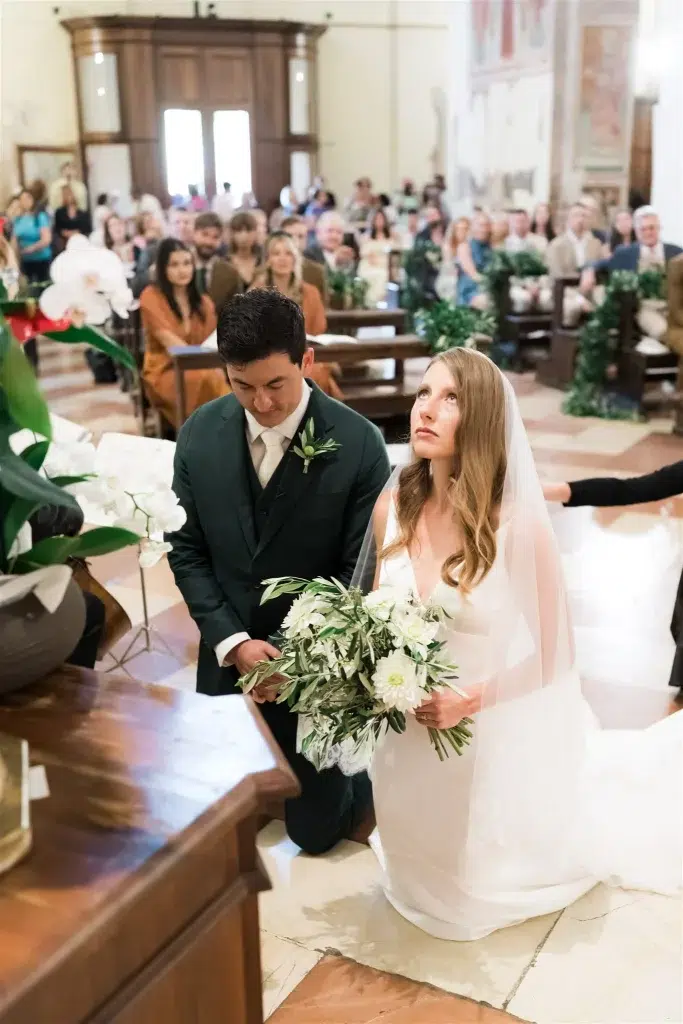
Italy is the only country where you can have a Catholic wedding with full civil validity performed by a priest. This unique form of marriage, known as “matrimonio concordatario,” allows a couple to combine religious and legal elements in one single, meaningful ceremony.
📜 Legal Foundations of the Matrimonio Concordatario
Modern states are typically secular, but Italy’s strong historical and cultural ties to Catholicism have influenced its legal system. Marriage in Italy reflects this deeply rooted connection.
The legal recognition of Catholic weddings is based on:
- The Concordat of 1929 (Legge No. 847 of May 27, 1929)
- The Revision Agreement of 1984 with the Holy See (including an additional protocol)
While some provisions of the 1929 Concordat were later abrogated, the core legal recognition remains in place.
🔎 Do Foreign Citizens Need Marriage Banns?
Since June 1992, foreigners who are not domiciled or resident in Italy are no longer required to post marriage banns for a religious-civil wedding (Italian Civil Code, Art. 115-bis; Gazzetta Ufficiale No. 127, June 1, 1992).
However, the following steps are mandatory:
- Declaration at the Town Hall 📍
The couple must apply in advance to the Registrar of the Municipality where the church is located. - Present the required documents 📑
- Valid passports or ID cards
- A Nulla Osta from their country of origin (issued by their Consulate in Italy), if applicable under international conventions (e.g., London, Vienna, or Munich)
- Religious documentation 🙏
- Documents from their home Parish
- A Nulla Osta from the local Curia (diocesan authority)
⛪ After the Ceremony: Transcription and Legal Recognition
Once the wedding takes place in the Church:
- The officiating priest is legally required to submit the marriage certificate to the civil registrar of the Municipality where the church is located.
- The civil registrar then transcribes the certificate into Italy’s official records, giving the marriage full legal effect.
🛂 Legalization and Use Abroad: Apostille and Translation
After your marriage is registered in Italy, here’s what happens next if you want it recognized abroad:
- Obtain the Italian Marriage Certificate 📄
You can request certified copies from the Municipality. - Check International Conventions 🌍
Depending on your country’s agreements with Italy, further steps may be necessary:- Hague Convention countries require an Apostille
- Non-Hague countries may require legalization through the Consulate
- Sworn Translation (Asseverazione) 🗣️
If your country requires a translation:- We will provide a professional translator certified to work in Italian courts
- The translator will complete the asseverazione (sworn translation process)
- Second Apostille on the Translation 🧾
After the translation is sworn, it needs a second Apostille from the Prosecutor’s Office (Procura della Repubblica) in the same court.
✅ Why Couples Trust Us for Their Religious-Civil Weddings in Italy
- 💼 We coordinate directly with local Parishes, Dioceses, and Municipalities
- ✍️ We assist in completing all civil and religious paperwork
- 🔁 We manage Apostilles and sworn translations
- 🇺🇸 We ensure recognition of your marriage in your home country

Written by Alessandro Pirrò
Alessandro is a former legal advisor to the Italian Government and has worked with top law firms in Rome, focusing on international marriage and recognition abroad. He now supports foreign couples getting legally married in Italy, offering expert guidance on paperwork, consular requirements and legal recognition in their home country.
Who will be your Legal Counselors in Italy?

Due to our experience in law firms and the foreign offices of the Italian public administration, we gained significant expertise in Consular affairs, and we are trained to solve the most complicated procedure such as:
People with refugee status who have requested asylum in Italy.
For all other matters, please visit our FAQ section.
Marriage Nulla osta process, legalization procedure, Court hearings for the refusal of the town hall when there documents missing , legal translation, apostille procedure, emergency procedure for legalization.
Immigration law services and consular support for non-EU citizens applying for a Schengen visa.
Family reunification and family cohesion.
Same-sex couples that want to celebrate a civil union in Italy when in their country the union is forbidden.
Couples that come from countries where divorce is not allowed;
Italians living abroadregistered at A.I.R.E. that need to recover their document to start the marriage banns in the Italian Consulate.
Assistance with people that come from countries that do not release the nulla osta.
American and Australian couples who needs assistance with “atto notorio” in an Italian Court or the Italian Consulate in the USA or Australia.


