
How U.S. Citizens Can Obtain the Atto Notorio for a Civil Wedding in Italy
📍 In this guide, we explain how to:
✔ Obtain the Atto Notorio in Italy hassle-free
✔ Navigate the Atto Notorio process efficiently
✔ Ensure full compliance with Italian Law
✔ Where the Atto Notorio should be obtained to makes things easier
About the Author
Alessandro Pirrò is a former Italian lawyer specializing in international civil marriages in Italy and consular affairs. He assists foreign couples throughout the marriage process, including procedures before Italian municipalities, consulates, courts, and prefectures, as well as the international recognition of Italian civil marriages abroad and matrimonial property regime matters.
The Atto Notorio can be obtained either at the Italian Consulate in the United States that is competent for the area where the Italian spouse resides, or directly at the Courthouse in Italy.
In practice, obtaining the Atto Notorio through the Italian Consulate in the United States is often more time-consuming and document-intensive.
Generally, the Italian Consulate will require a birth certificate that has been apostilled by the competent Secretary of State.
The document must then be translated into Italian.
The translation may be prepared by any person, who must subsequently appear before an Italian consular officer and formally declare that the translation is accurate. This declaration is made under the legal responsibility of the person who prepared the translation.
If the American citizen is divorced or widowed, the same procedure usually applies to the divorce decree or the death certificate of the former spouse, both of which must generally be apostilled and translated into Italian.
Furthermore, Italian Consulates in the United States generally apply the rules governing the Atto Notorio strictly. In practice, this often means that four witnesses are required and that close relatives cannot act as witnesses. (In Italy two witness are generally required).
Obtaining the Atto Notorio in Italy is often considerably simpler.
In Italy, the American citizen appears before the competent Italian Court official and declares that, according to the laws of the U.S. state in which they reside, there are no impediments to the marriage.
‼️In many courts, it is therefore possible to complete the procedure without first obtaining apostilles and certified translations of supporting documents.
For this reason, we generally recommend obtaining the Atto Notorio in Italy.
This approach can avoid the burden of collecting documents, obtaining apostilles in the United States, and arranging translations for consular purposes.
Of course, it is important to attend a court that is familiar with this procedure and applies the relevant rules in a practical and efficient manner.
Over the years, we have developed working relationships with Italian courts that regularly handle these matters.
It should also be noted that Italian law does not expressly require American citizens to produce documents such as birth certificates, divorce decrees, or death certificates of a former spouse in order to make the declarations contained in the Atto Notorio.
The purpose of the Atto Notorio is precisely to allow a person to declare facts, personal status, and legal circumstances under their own responsibility.
For this reason, the declaration itself is the central element of the procedure.
This interpretation is consistent with the framework established by Italian law and with the special arrangements applicable to U.S. citizens under Law (Legge) No. 1195 of 13 October 1965.
Naturally, both the Italian Consulate in the United States and the competent Italian court retain the discretion to request additional documentation in specific cases.
This distinction is important because many American citizens feel overwhelmed by what appears to be a complex bureaucratic process.
👉🏻In reality, there are lawful and fully legitimate ways to simplify the procedure while remaining fully compliant with Italian law.
That is how we work: respecting the law while making the process as efficient as possible for U.S. citizens who wish to marry in Italy.
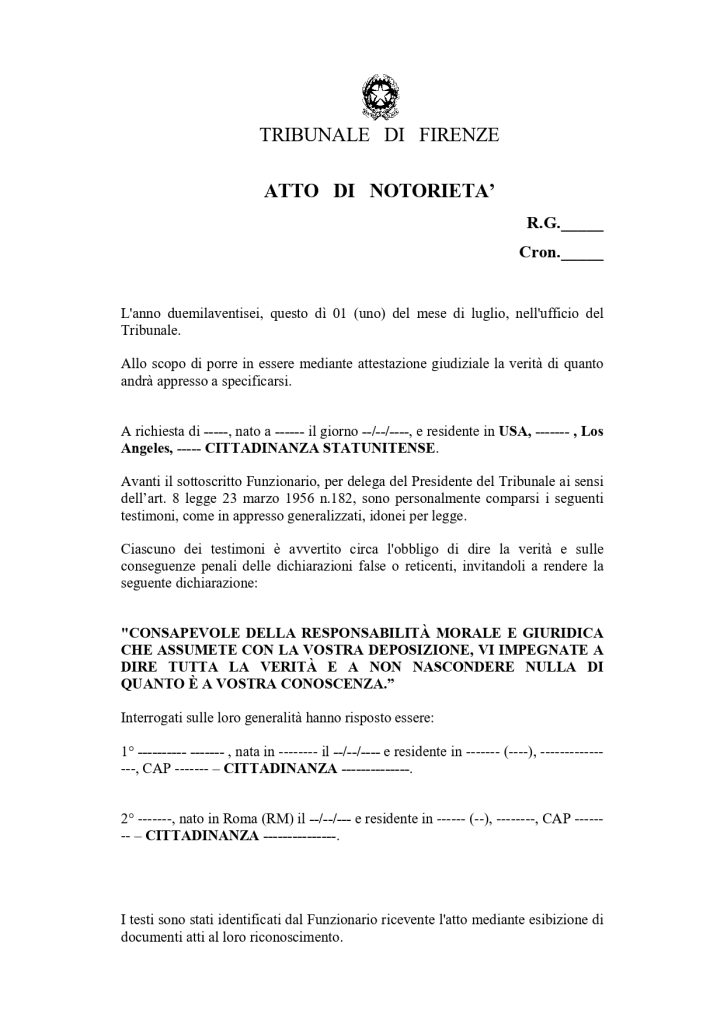
Picture of an Atto Notorio
Marriage Procedure with the Italian Municipality
Once the atto notorio and the legalized “dichiarazione giurata”(sworn statement) have been obtained, the final phase takes place before the Italian Municipality where the civil wedding will be celebrated.
At this stage, the procedure depends on the nationality and residency status of the couple.
1️⃣ If One of the Spouses Is an Italian Citizen
If one of you is an Italian citizen, the Municipality will generally require the publication of the marriage banns (pubblicazioni di matrimonio).
The Municipality must complete the publication period before the wedding can legally take place.
The publication period lasts 11 consecutive days: 8 days of publication plus an additional 3 days allowed by Italian law for the filing of any legal opposition to the marriage.
If the Italian citizen resides in Italy, the banns are handled by the Municipality of residence.
If the Italian citizen is registered with A.I.R.E. and resides abroad, the banns must be initiated through the competent Italian Consulate responsible for that person’s place of residence.
If the other spouse is American, the procedure is slightly different.
When one of the spouses is an Italian citizen residing in the United States, the first stage of the marriage process usually begins with the marriage banns before the competent Italian Consulate in the U.S., rather than directly before the Italian municipality where the wedding will take place.
The American spouse must also prepare the required declaration of no impediment to marriage.
In this case, the sworn statement is generally signed before a U.S. Notary Public and then apostilled by the competent Secretary of State.
The document must then be translated into Italian. In practice, this translation is usually certified through the Italian Consulate in the U.S. under the “certificazione conformità di traduzione” procedure.
Afterwards, the U.S. spouse will also need to complete the Atto Notorio before the Italian Consulate in the U.S.
Unlike the American sworn statement, the Atto Notorio does not need to be translated or legalized, because it is already an Italian public act issued by an Italian authority.
At this point the U.S. citizen has everything necessary to begin the marriage banns procedure together with the Italian spouse.
If one of the future spouses does not speak Italian, an interpreter is normally required during the banns procedure.
Italian law also allows one spouse to attend the banns appointment on behalf of the other through a special delegation when there is a legitimate reason preventing personal attendance.
2️⃣ If Both Spouses Are Foreign Citizens Living Outside Italy
If neither spouse resides in Italy and both are foreign nationals, marriage banns are not required.
Instead, the couple signs a declaration directly before the Civil Registrar of the Municipality where the civil wedding will take place.
This declaration is generally made one or two days before the wedding. The exact date and time are determined at the discretion of the Municipality where the marriage will be celebrated.
If one or both spouses do not speak Italian, an interpreter is required both for the declaration and for the civil ceremony itself.
We prepare the necessary documentation, coordinate with the Municipality, schedule the appointment, assist throughout the process, and arrange the interpreter’s oath when required.
During the civil ceremony, the Mayor or their delegate reads the provisions of the Italian Civil Code concerning the rights and duties arising from marriage.
The Civil Registrar then verifies the identity of the spouses, asks whether they intend to marry each other, and records their choice regarding the law applicable to their matrimonial property regime.
Under Article 22 of Regulation (EU) 2016/1103, spouses may choose the law of the State of nationality or residence of either spouse to govern their matrimonial property regime.
After the Civil Wedding: Recognition of the Marriage in the United States
Italy and the United States are both parties to the Hague Convention of 5 October 1961, which abolished the requirement for diplomatic legalization of foreign public documents.
As a result, an Italian marriage certificate can be recognized in the United States through the apostille process.
The procedure normally involves the following steps:
- Obtaining the estratto per riassunto dell’atto di matrimonio from the Italian Municipality where the marriage was celebrated.
- Obtaining the apostille from the competent Prefettura.
- Translating the marriage certificate into English.
- Having the translation sworn before an Italian court.
- Obtaining a second apostille on the sworn translation from the competent Public Prosecutor’s Office (Procura della Repubblica).
Once the apostille and translation process has been completed, the Italian marriage certificate can be presented in the United States wherever proof of marriage is required.

📌 Who Are Your Legal Counselors in Italy?
📍 Our legal team specializes in:
✅ Marriage guide for US citizens marrying in Italy
✅ Court hearings for town hall refusals due to missing documents
✅ Legal translations & apostille certification
✅ Emergency legalization procedures
✅ Same-sex civil unions in Italy
✅ Marriage assistance for couples from countries where divorce is not allowed
✅ Marriage banns for Italians abroad registered with A.I.R.E.
✅ Legal support for U.S. citizens needing Atto Notorio.

