To marry in Italy, U.S. citizens need to:
- swear the “dichiarazione giurata” (sworn statement) before the U.S. Consulate in Italy
- have the consular signature legalized by the competent Prefettura
- obtain an “atto notorio”, either before a court in Italy or at the Italian Consulate in the U.S.
- submit these documents to the Comune (town hall) where you will marry, which reviews them
- if neither of you is resident in Italy, attend the town hall appointment where you both declare that there are no impediments of kinship, affinity, adoption or affiliation between you under art. 87, nos. 1, 2 and 4 of the Civil Code, and no other impediments under arts. 85, 86 and 88 of the same Code
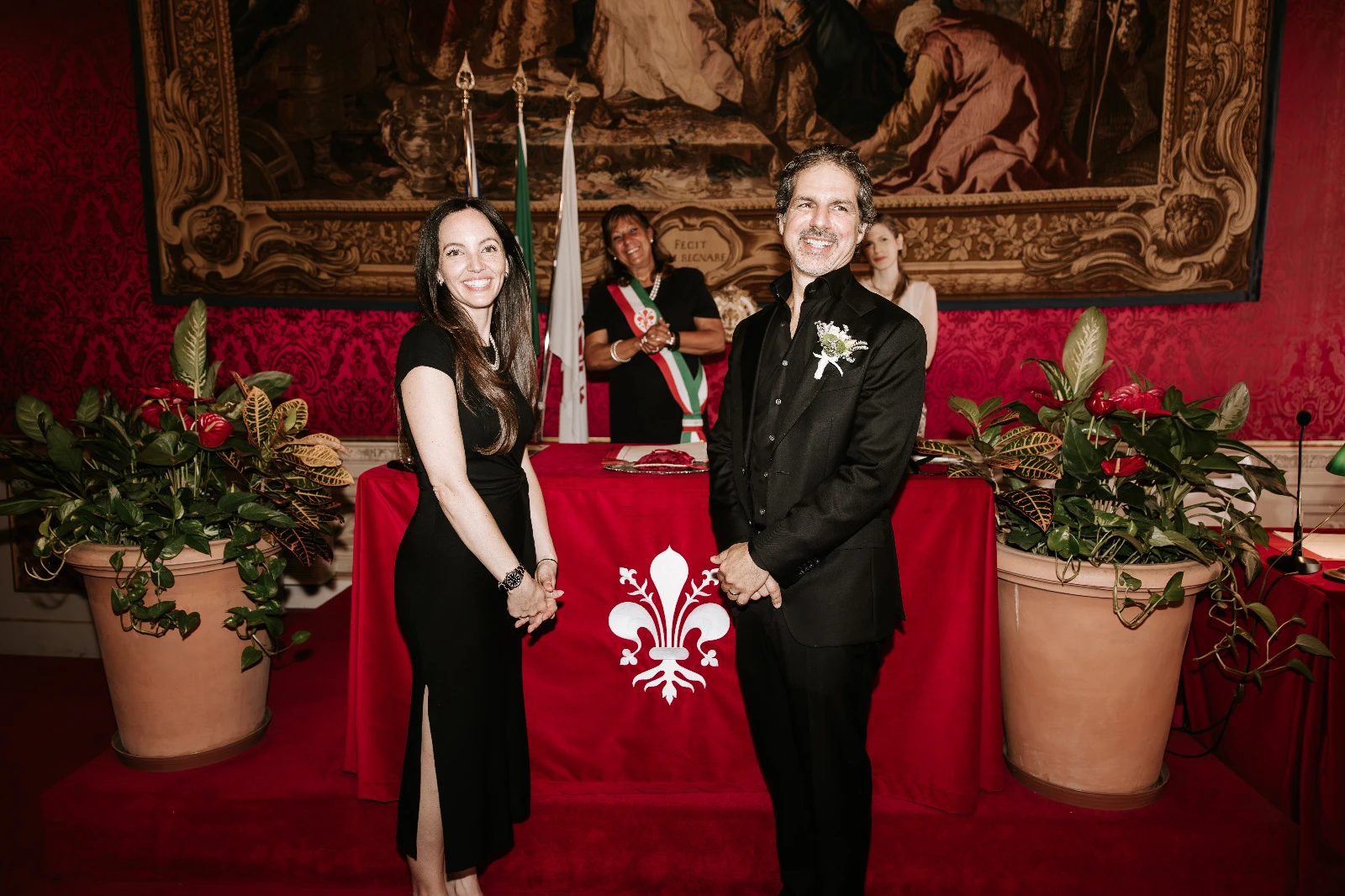
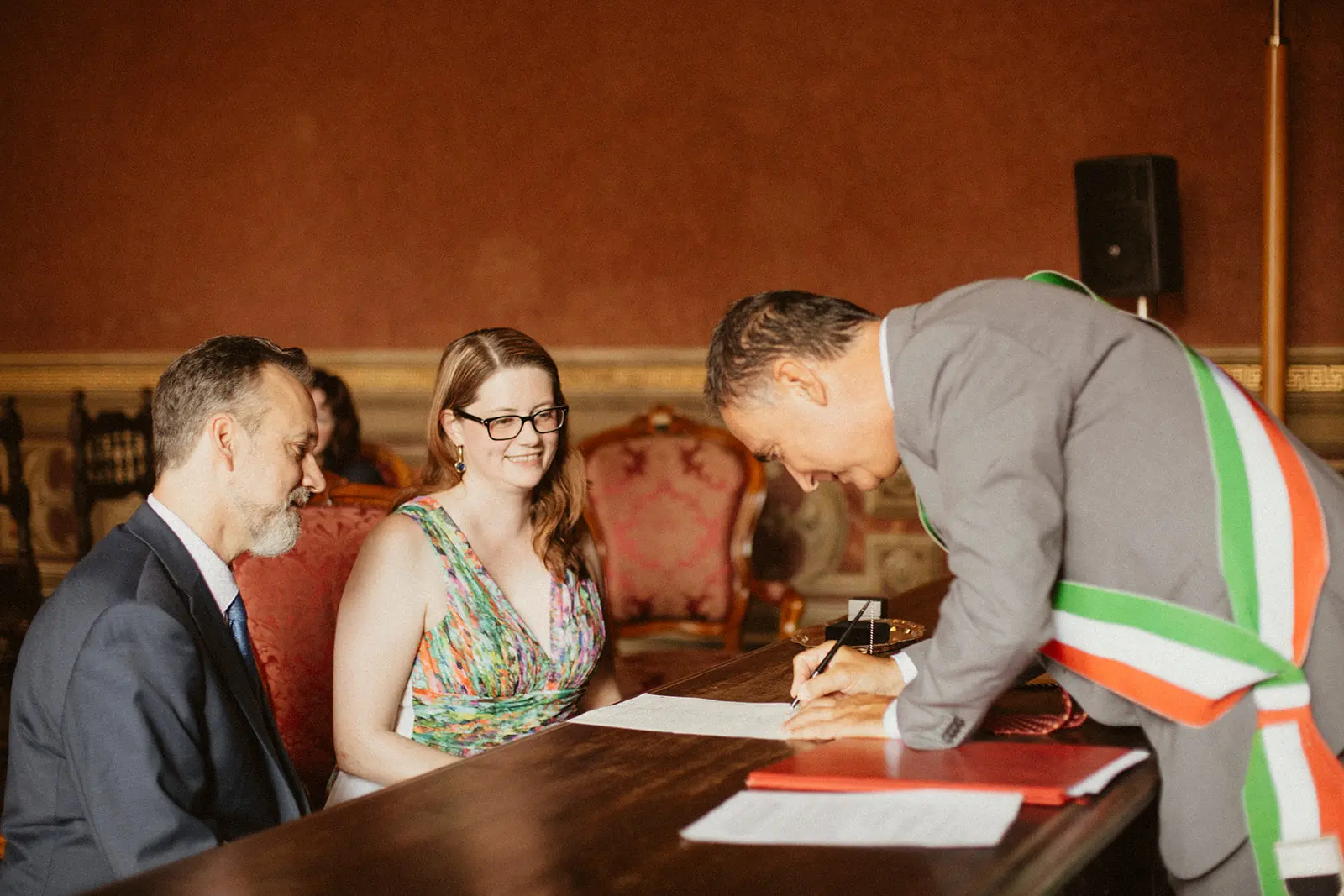
- celebrate the civil wedding before the Mayor or their deputy, with two witnesses and an interpreter if needed.
Quick Answers for U.S. Citizens
The questions American couples ask us most often. The full procedure follows below.
Can U.S. citizens legally marry in Italy?
Yes. A civil ceremony at an Italian town hall is a valid marriage under Italian law.
Do U.S. citizens need a Nulla Osta to marry in Italy?
No. The United States does not issue a Nulla Osta, so U.S. citizens follow a different procedure accepted under Italian law.
What document replaces the Nulla Osta for U.S. citizens?
A sworn statement signed before a U.S. consular officer in Italy, declaring that there are no legal impediments to the marriage.
Does the U.S. consular affidavit need legalization?
Yes. The Prefettura has to legalize the consular signature before Italian authorities will accept the document.
Is an atto notorio required for U.S. citizens?
In many cases, yes. Italian authorities may ask for it, and it is usually sworn before an Italian court with witnesses.
Is a marriage performed in Italy valid in the United States?
Yes. A civil marriage legally performed in Italy is generally recognized in the United States, provided it complies with Italian law.
Is an Italian marriage valid in the U.S. if there is a prenuptial agreement?
Yes. A prenuptial agreement signed in the United States does not affect the validity of the Italian marriage. The marriage extract (estratto per riassunto) can also record the law the couple has chosen for their property regime. That extract is apostilled, translated, sworn before an Italian court and apostilled again on the translation, so it can be used in the United States.
Below you will find every step in order, from the appointment at the U.S. Consulate to the documents you will need back home.
- U.S. Consular “dichiarazione giurata” (Sworn Statement)
- Legalization of the “Dichiarazione giurata” (Sworn Statement)
- Atto Notorio
- How Many Witnesses for the Atto Notorio
- Declaration of no impediments at Town Hall
- Legal Wedding Ceremony in Italy
- Making the Marriage Valid in the U.S.
- Choosing the Applicable Property Law
- What documents U.S. Citizens need to marry in Italy
Step-by-Step Legal Procedure for U.S. Citizens
Step 1: Sign the Dichiarazione Giurata at the U.S. Consulate
The couple goes to the U.S. Consulate in Italy to sign the dichiarazione giurata, a sworn statement that there are no legal impediments to the marriage under the laws of the State where the applicant lives.
You sign it in front of the U.S. consular officer. It cannot be signed in advance.
For U.S. citizens, this document replaces the Nulla Osta required under Article 116 of the Italian Civil Code.
Italy accepts it on the basis of the exchange of notes between Italy and the United States ratified by Law no. 1195 of 13 October 1965.
Step 2: Legalize the Dichiarazione Giurata at the Prefettura
Next, the dichiarazione giurata has to be legalized by the competent prefettura.
This usually happens right after the consular appointment, often on the same day.
Without it, the town hall will not accept the document. The signature of the U.S. Consul or their deputy is registered with one specific prefettura, and only that office can verify and legalize it. No other prefettura can do it.
Technically, the dichiarazione giurata is a foreign document. Legalization is what allows the Italian legal system to recognize it.
The prefettura checks the consular signature against the one on file and, if it matches, applies its legalization stamp. From that moment the sworn statement is valid in Italy.
Only then can it go to the town hall, together with the atto notorio described in the next step.
Both documents expire. Under Italian law:
- the consular dichiarazione giurata, like every marriage Nulla Osta, is valid for 180 days;
- the atto notorio is valid for 90 days.
In practice we get the legalized dichiarazione giurata and the atto notorio on the same day. By about 2 p.m. you have both in hand and can move on to the town hall.
Step 3: Obtain the Atto Notorio
The quickest route: an Italian court
The couple appears before an Italian court, with us, to obtain the atto notorio, a formal declaration that both partners are free to marry.
The atto notorio is not technically an oath, but you make it under your personal legal responsibility, and a false declaration is a criminal offence under Italian law.
That is why Italian authorities treat it as a reliable document, and why it carries so much weight when U.S. citizens marry in Italy.
We draft the atto notorio for you. Depending on the court, it is drawn up as one joint act for both partners or as two separate acts. Italian diplomatic and consular offices in the United States generally require two separate acts, one for each U.S. citizen.
We also provide the witnesses: two or four, depending on what the Comune where you marry confirms (more on this below). Witnesses must be unrelated to the U.S. citizen by blood or marriage and must have no legal interest in the effects of the atto notorio.
If we handle the procedure, all you need is a valid passport. Some courts ask for an interpreter. We book the fast-track slot so you receive the atto notorio the same day and your wedding timeline stays on track.
The atto notorio confirms that there are no legal barriers to the marriage under Italian and U.S. law.
Atto Notorio at the Italian Consulate in the U.S.
You can also get the atto notorio from the Italian Consulate that covers your area in the U.S. Expect it to take longer: consulates often have long waiting lists and limited staff.
Consulates are also stricter about paperwork. They usually ask for your birth certificate and, if relevant, your divorce decree or the death certificate of a previous spouse. Each document needs an apostille under the Hague Convention of 5 October 1961, issued by the competent Secretary of State, and an Italian translation. The translator then swears to the accuracy of the translation, a step called dichiarazione di conformità.
For these reasons we always suggest getting the atto notorio in Italy. The court we work with does not ask for any additional documents, and the procedure is simpler and faster.
How Many Witnesses for the Atto Notorio: Two or Four?
Italian law provides for two witnesses for the atto notorio under Article 30 of Law no. 241/1990. For U.S. citizens who intend to marry in Italy, however, the bilateral agreement between Italy and the United States, implemented by Law no. 1195/1965, provides for four witnesses.
Law no. 1195/1965 is a special law, because it applies only to U.S. citizens. Under the principle of speciality, a special law should prevail over the general rule. In practice, the competent offices interpret these provisions differently.
In our experience, Italian Consulates abroad apply the special law and ask U.S. citizens to bring four witnesses. The Italian courts we have worked with accept two.
The suitability of the atto notorio for the marriage is assessed by the civil registrar of the Comune where the wedding will take place, not by the Court that receives the declaration. Some town halls tell couples that the Court decides. It does not.
We therefore recommend asking the Civil Registry Office (Ufficio di Stato Civile) of the Comune where you will marry, or of the Comune where the marriage banns will be requested if different, to confirm in advance whether two or four witnesses are required. The same applies when the marriage banns must be requested at an Italian Consulate abroad, for example when one of the partners is an Italian citizen living abroad and registered with AIRE. In that case, the requirements should be checked in advance with the competent Consulate, also taking into account the instructions of the Comune where the marriage will be celebrated.
There is more on this in our guide to the atto notorio for U.S. citizens.
Step 4: Declare Absence of Impediments at Town Hall
A day or two before the wedding, the couple declares at the town hall that:
- there are no impediments of kinship, adoption, affiliation or affinity (art. 87, nos. 1, 2 and 4 of the Italian Civil Code);
- there are no other impediments under arts. 85, 86 and 88 of the Civil Code.
If one of you does not speak Italian fluently, an interpreter must be present. No witnesses are needed at this appointment.
Special Case: One Partner Resident in Italy or Registered with AIRE
The procedure above does not apply if either partner is resident in Italy or is an Italian citizen living abroad. That includes dual U.S.-Italian citizens permanently resident in the United States.
In these cases Italian law requires marriage banns (pubblicazioni di matrimonio).
If the Italian partner is resident in Italy, the banns are filed with the Comune of residence.
If the Italian partner lives in the United States and is registered with A.I.R.E. (dual citizens included), the banns start at the competent Italian Consulate in the U.S. To find out which Consulate covers your area, for the banns or for the atto notorio, use the Consulate Finder of the Italian Ministry of Foreign Affairs.
This second case works differently. Since the Italian partner lives permanently in the United States, the Italian Consulate there reviews the marriage documents.
To spare the American partner a trip to the U.S. Consulate in Italy, the dichiarazione giurata can be replaced by a sworn statement before a notary public in the U.S., with an apostille from the competent Secretary of State. The statement is then translated into Italian, and the Italian Consulate authenticates the translation through the “certificazione conformità di traduzione” procedure.
The apostilled and translated statement goes to the Italian Consulate in the United States together with the atto notorio, and the banns procedure can start.
The banns are posted for 8 consecutive days, followed by a 3-day waiting period. The couple can marry only after that.
When the banns go through the Consulate, the Consulate sends a formal delegation (delega) to the Comune you have chosen for the wedding, which can be any Comune in Italy.
When the banns are done in Italy, because one of you is resident there, you can marry in the Comune where the banns started or in any other Comune that agrees to celebrate the wedding.
Step 5: Celebrate Your Legal Wedding in Italy
The ceremony takes place at the town hall before the Mayor (or delegate), with two witnesses holding a valid ID and, if needed, an interpreter.
This ceremony is your legally binding civil wedding in Italy.
Step 6: Post-Wedding Documents to Ensure Your Marriage Is Valid in the U.S.
To make sure your marriage is valid in the United States, we:
- request an official Italian marriage certificate from the town hall, usually the estratto per riassunto dell’atto di matrimonio, because it records the law you have chosen to govern your property regime;
- ask the competent Prefettura for an apostille under the Hague Convention, to which both Italy and the U.S. are parties, so the certificate is recognized in the U.S.;
- have a professional translator, at our expense, translate the certificate by asseverazione (sworn translation) at the Italian court;
- obtain a second apostille on the translation from the competent Public Prosecutor’s Office, since the translation must also be valid in the U.S. legal system.
With two apostilles, one on the original and one on the translation, both documents are recognized under the Hague Convention.
Choosing the Law for Your Property Regime
Many couples marrying in Italy overlook their matrimonial property regime.
Under article 22 of European Regulation 2016/1103 of 24 June 2016, spouses have the right to choose the law that will govern their matrimonial property regime instead of having it determined automatically by conflict-of-law rules.
Before or at the civil wedding, the couple can formally ask for their property regime to be governed by:
- the law of a State of which one of the spouses is a citizen; or
- the law of a State in which one of the spouses is habitually resident.
For American couples this matters, because it keeps the marriage in Italy consistent with their legal and financial planning back home.
The choice is not automatic. You have to declare it expressly during the marriage procedure, and when you do, the Italian authorities must record it in the marriage records.
After the wedding you can request the estratto per riassunto dell’atto di matrimonio.
It is the only Italian marriage certificate that shows the law the spouses chose for their property regime.
Neither the full marriage certificate nor the multilingual extract (estratto plurilingue) under the Vienna Convention contains this information.
If you may ever need to prove abroad which law governs your property regime, this is the certificate to ask for.
Special Case: Women Divorced Within the Previous 300 Days
Italian law provides special rules for women whose previous marriage ended less than 300 days before the intended wedding date.
In these cases, an authorization must generally be obtained from the competent Italian Court before the marriage can proceed.
The court may waive the 300-day waiting period upon presentation of appropriate evidence demonstrating that there is no possibility of confusion regarding paternity.
We handle this procedure regularly. We prepare the application and the medical documentation and deal directly with the court.

FAQ: American citizens getting married in Italy
Which documents do American citizens need to get married in Italy?
Mostly sworn declarations made in Italy: the sworn statement at the U.S. Consulate in Italy, legalized by the competent Prefettura, and, in practice, an atto notorio before an Italian court. Some Comuni also require a declaration at the town hall before the wedding. We check what your Comune requires in advance.
If you entrust the procedure to us, you only need a valid U.S. passport. We draft the sworn statement and the atto notorio on the official templates used by the U.S. Consulate and the Italian court.
Do U.S. citizens need a visa to marry in Italy?
For stays of up to 90 days in the Schengen area, U.S. citizens normally do not need a visa. The usual entry rules still apply, such as passport validity.
What is a Nulla Osta, and is it required for U.S. citizens?
In Italy, the general rule for foreign citizens is the Nulla Osta under Article 116 of the Italian Civil Code. The United States does not issue one. U.S. citizens instead sign a sworn statement at the U.S. Consulate in Italy, have it legalized by the competent Prefettura and, as many Comuni require, obtain an atto notorio before an Italian court.
Do U.S. citizens need to bring documents from the United States?
It depends on who handles your case. When we arrange the atto notorio in Italy, we work with authorities that do not ask for a U.S. birth certificate, a divorce decree or the death certificate of a previous spouse. Others, such as Italian Consulates in the United States, some Italian courts or some Comuni, may ask for these documents, apostilled and translated into Italian.
Can the entire legal process be completed in one day?
Usually, yes. With the appointments lined up, the sworn statement at the U.S. Consulate, the legalization at the Prefettura and the atto notorio at the court can be done in one working day.
How long does the overall process take?
We usually plan around 10 business days, mainly because of the town hall’s own timing for the pre-wedding steps and the document check. The consular statement, the legalization and the atto notorio take one day, but the Comune may need more.
Are witnesses required?
Yes. The civil ceremony needs two witnesses. For the atto notorio you may need two or four, depending on how the Comune where you marry reads the law, so we check with the Comune first (see how many witnesses). Witnesses must be legally competent and have no direct interest in the act. Many offices do not accept close relatives, and we check the local practice. If you have no eligible witnesses, we provide them.
Do we need an interpreter?
Yes, if either of you is not fluent in Italian. We can provide an interpreter used to civil registry procedures. The interpreter cannot also act as a witness.
What is an Apostille, and why do we need it for U.S. use?
An apostille certifies the signature on an Italian public document so it can be used abroad, under the 1961 Hague Convention. After the wedding we get one apostille on the original marriage certificate from the competent Prefettura, and a second one on the sworn English translation from the competent Public Prosecutor’s Office (Procura della Repubblica), because the sworn translation is a court act.
Do you handle the full legal process, including post-wedding documents?
Yes. We book the court appointment for the atto notorio, the U.S. Consulate appointment in Italy for the sworn statement and the town hall steps, ceremony included. We arrange interpreters when needed, and after the wedding we handle the sworn translation (asseverazione) and the apostilles for the United States.
The multilingual marriage certificate issued under the Vienna Convention cannot be used in the U.S., because the United States is not a party to that Convention. For the U.S. we use the right Italian marriage certificate, with apostille and sworn translation.
What if one partner is Italian, or resident in Italy with another nationality?
Then marriage banns (pubblicazioni di matrimonio) are required. They are posted for 8 consecutive days, followed by a 3-day waiting period. They start with the authority competent for the Italian partner: the Comune of residence if they live in Italy, or the competent Italian Consulate if they live abroad and are registered with A.I.R.E. We handle the banns and deal directly with the Comune or the Consulate.
How do we ensure our Italian wedding is valid for U.S. legal purposes?
After the wedding we prepare the documents for the U.S.: an apostille from the competent Prefettura on the Italian marriage certificate, an English translation sworn at the Italian court (asseverazione), and a second apostille on that translation from the competent Public Prosecutor’s Office. You can then use the certificate for legal and administrative purposes in the United States.
When should we start organizing appointments?
As soon as you have a date and a Comune. We book the appointments early so they fit the town hall’s schedule.
How many days in advance should we arrive in Italy?
We usually suggest arriving at least 10 business days before the wedding. We group the legal steps together so you spend as little time in offices as possible.
Do we need to visit many offices?
You only need to be there for the atto notorio at the court, the sworn statement at the U.S. Consulate in Italy, the town hall declaration (or the banns, when required) and the ceremony. We take care of the rest.
Can U.S. citizens choose U.S. law for their property regime?
Yes. Under Article 22 of EU Regulation 2016/1103, spouses can choose U.S. law, or the law of another nationality held by one of them, for their property regime. We ask the Comune to record the choice in the Italian marriage certificate.
For more on recognition at home, read our article on whether a marriage in Italy is valid in the U.S.
Written by Alessandro Pirrò
Alessandro is an Italian legal consultant specialized in civil marriages in Italy for foreign citizens, especially from the United States. He holds a Master’s degree in Law from the University of Rome Tor Vergata, completed his legal traineeship at law firms in Rome, and from 2016 to 2020 worked as a freelance legal consultant for the Italian Ministry of Education, University and Research (MIUR). He is not a registered lawyer (avvocato).
How We Can Help

We also help U.S. citizens with:
- understanding the Nulla Osta
- Catholic weddings in Italy for American citizens
- the atto notorio