
🇷🇴 Legal Requirements for Romanian Citizens Getting Married in Italy
A Romanian citizen who wishes to get legally married in Italy must submit a Nulla Osta to the Italian Municipality where the marriage will take place.
The Nulla Osta is issued by the competent Romanian consular authority in Italy and confirms that there are no impediments to the marriage under Romanian law.
The procedure depends primarily on one factor: where the parties are legally resident.
If both parties are foreign citizens and neither has residence or domicile in Italy, marriage banns are not required. If, however, at least one of the parties is resident in Italy, the marriage banns procedure must also be completed.
In brief: what does a Romanian citizen need to get married in Italy?
In general, the legal procedure involves:
- verification of personal and civil status documents;
- obtaining the Nulla Osta to marriage from the competent Romanian consular authority in Italy;
- prior verification of the documents with the Italian Municipality where the marriage will take place;
- marriage banns, if one of the parties is resident in Italy, regardless of nationality;
- marriage banns through the competent Italian Consulate abroad if one of the parties is an Italian citizen residing abroad and registered with AIRE;
- declarations before the Italian Civil Status Officer confirming that there are no impediments to the marriage under Italian law;
- celebration of the civil marriage;
- issuance of the multilingual marriage extract under the Vienna Convention of 8 September 1976, which can be used in Romania and other contracting States without translation or legalization, and/or the Italian marriage certificate, extract of the marriage record or full copy of the marriage record.
The documents must always be assessed according to the personal circumstances of the parties, particularly in cases involving previous marriages, divorce, widowhood, dual nationality or residence in different countries.
Documents normally required by the Romanian Consulate in Italy
Depending on the competent Romanian consular office and the personal circumstances of the Romanian citizen, the following documents may be required:
- valid Romanian passport or national identity card;
- birth certificate;
- documents relating to marital status;
- copy of the future spouse’s identity document;
- in the case of a previous marriage, documents relating to the divorce or death of the former spouse.
The final list should always be verified with the competent Romanian Consulate before beginning the procedure, as additional documentation may be required depending on the applicant’s marital status and personal circumstances.
Nulla Osta for Romanian citizens getting married in Italy
The Nulla Osta to marriage is the document through which the competent foreign authority certifies that, under the national law of the citizen concerned, there are no legal impediments to the marriage.
A Romanian citizen must therefore coordinate the issuance of the required documentation with the competent Romanian authority and verify in advance that the Nulla Osta contains all the information required by the Italian Municipality.
An important point concerns legalization.
When the document is issued by a Romanian diplomatic or consular authority in Italy, subsequent legalization of the signature by the Italian Prefettura is not required under Regulation (EU) 2016/1191.
The Regulation applies to public documents relating, among other matters, to marriage, capacity to marry and marital status, and simplifies the circulation of these documents between EU Member States.
Documents issued directly in Romania must be considered separately, as the applicable formalities depend on the nature and form of the individual document.
Are marriage banns required in Italy?
It depends on the residence of the parties.
If both parties are foreign citizens and are not resident in Italy
If both parties are foreign citizens, have neither residence nor domicile in Italy and are travelling to Italy to get married, marriage banns are not required.
The Italian Municipality must nevertheless receive and verify the necessary documentation before the ceremony.
Before the marriage, the Municipality will also prepare the required record in which the parties declare that there are no impediments between them arising from kinship, affinity, adoption or affiliation under Article 87, numbers 1, 2 and 4 of the Italian Civil Code, and that none of the other impediments provided for by Articles 85, 86 and 88 of the Civil Code apply.
If one of the parties is resident in Italy
If the foreign citizen is resident or domiciled in Italy, Article 116 of the Italian Civil Code also requires the publication of marriage banns.
The banns are handled by the competent Italian Municipality and are published on its online public notice board for eight consecutive days.
Once the publication period has ended, the additional statutory period for possible objections must also expire before the marriage can take place.
Marriage banns are valid only for a limited period, and the marriage must therefore be celebrated within the applicable statutory deadline.
Declaration before the Italian Civil Status Officer
Before the marriage, the Municipality may require the parties to appear before the Civil Status Officer to complete the necessary declarations and confirm that there are no impediments to the marriage under Italian law.
The exact procedure and the date of the appointment depend on the Municipality where the civil marriage will take place.
For this reason, travel should not be arranged solely on the basis of a standard timetable. The Municipality’s availability and prior approval of the documentation should be coordinated before travelling to Italy.
If either party does not have a sufficient understanding of Italian, an interpreter will be required.
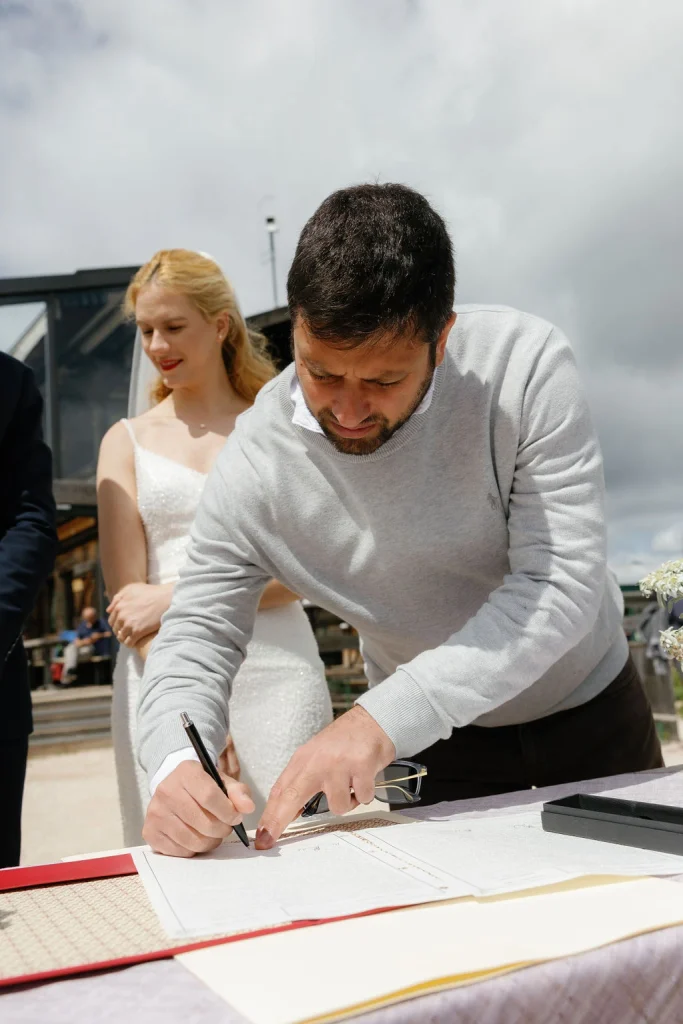
The civil wedding ceremony in Italy
A civil marriage in Italy is celebrated before the Mayor, the Civil Status Officer or another person formally delegated to perform the marriage.
The ceremony requires:
- both parties;
- two adult witnesses with valid identification;
- an interpreter, where required.
The Municipality may also charge a ceremony fee, particularly when the marriage takes place in a specific municipal venue, in an authorized venue outside the Town Hall, or on particular days or at particular times.
Romanian citizens residing in Italy
For Romanian citizens who are resident in Italy, the procedure normally requires greater coordination with the Italian Municipality of residence.
Once the required documents and the Nulla Osta have been obtained, the Municipality carries out the necessary checks and, where applicable, begins the marriage banns procedure.
If the parties are resident in different Italian Municipalities, the respective Civil Status Offices coordinate the publication of the banns according to their places of residence.
Once the procedure has been completed, the marriage may take place in the competent Municipality or, where permitted, in another Italian Municipality through the necessary authorization and delegation.
What if one of the parties is an Italian citizen registered with AIRE?
AIRE: Anagrafe degli Italiani Residenti all’Estero, applies exclusively to Italian citizens residing abroad.
It therefore does not apply to a Romanian citizen simply by virtue of Romanian nationality.
It becomes relevant, however, when a Romanian citizen is marrying an Italian citizen who lives abroad and is registered with AIRE.
In this situation, the Italian citizen’s position must be coordinated with the competent Italian Consulate abroad. The Consulate will review the parties’ documentation and civil status and will also carry out the marriage banns procedure.
Once the banns have been completed without opposition, the Italian Consulate will transmit the necessary delegation and documentation to the Italian Municipality where the parties intend to marry.
The procedure must therefore always be assessed on the basis of the nationality and residence of both parties.
Is a marriage celebrated in Italy valid in Romania?
After the civil ceremony, the Italian Municipality registers the marriage in its civil status records and can issue the relevant marriage certificate or extract.
Both Italy and Romania are parties to the Vienna Convention of 8 September 1976 on the issue of multilingual extracts from civil status records.
It is therefore possible to request a multilingual extract of the Italian marriage record issued in accordance with the Convention.
The practical advantage is significant: a multilingual extract issued under the Convention can be used in the contracting States without translation and without legalization or Apostille.
This does not, however, mean that the marriage is automatically entered into the Romanian civil status registers.
After the marriage, the Italian marriage record must be transcribed into the Romanian civil status registers, according to the procedure applicable to the spouses.
The transcription can be requested through the competent Romanian authorities in Romania or, where the applicable requirements are met, through the competent Romanian diplomatic or consular authority in Italy.
Legal assistance for Romanian citizens getting married in Italy
The most delicate part of an international marriage is not simply obtaining a number of certificates. It is ensuring that the Romanian authorities, the Italian Municipality and the parties’ personal documentation are correctly coordinated before the couple arrives in Italy.
We assist couples with the preliminary verification of their documents, coordination with the competent consular and municipal authorities, and the different stages of the procedure through to the issuance of the Italian marriage documentation.
Depending on the individual case, our assistance may include:
- preliminary verification of the documents;
- coordination of the Romanian Nulla Osta procedure;
- direct coordination with the Italian Municipality;
- marriage banns, where required;
- assessment of the matrimonial property regime;
- coordination of the necessary appointments;
- interpreter assistance;
- provision of witnesses where necessary;
- request for the marriage certificate or extract after the ceremony;
- documentary assistance for the subsequent use of the marriage record in Romania.
Each case is assessed on the basis of the parties’ nationality, residence, previous marital status and the Italian Municipality chosen for the marriage.
Frequently asked questions about Romanian citizens getting married in Italy
Can a Romanian citizen legally get married in Italy?
Yes. A Romanian citizen can enter into a legally valid civil marriage in Italy by obtaining the required Nulla Osta to marriage from the competent Romanian authority and submitting the documentation required by the Italian Municipality.
Does a Romanian citizen need a Nulla Osta to get married in Italy?
Yes. Article 116 of the Italian Civil Code requires a foreign citizen wishing to marry in Italy to provide a declaration from the competent authority of their country confirming that there are no impediments to the marriage under their national law.
For Romanian citizens, this requirement is generally fulfilled through the Romanian Nulla Osta.
Does a Romanian Nulla Osta need to be legalized by the Italian Prefettura?
If the document is issued by a Romanian diplomatic or consular authority in Italy and falls within the scope of Regulation (EU) 2016/1191, legalization by the Italian Prefettura is not required.
Documents issued directly in Romania should be assessed separately to determine which formalities apply to the specific document.
Do two Romanian citizens who are not resident in Italy need marriage banns?
No. If both parties are foreign citizens and neither has residence nor domicile in Italy, marriage banns are not required.
The Italian Municipality must nevertheless verify the documentation and complete the required formalities before the ceremony.
The couple will also normally need to appear before the Civil Status Office before the marriage to make the required declarations concerning the absence of legal impediments.
How many witnesses are required for a civil wedding in Italy?
A civil marriage in Italy requires two witnesses, each with valid identification.
Is an interpreter required?
If either party does not understand Italian sufficiently, an interpreter is required during the stages in which the person must understand or sign legally relevant declarations and during the civil ceremony itself.
Does an Italian marriage certificate need an Apostille for use in Romania?
If the Italian Municipality issues a multilingual marriage extract under the Vienna Convention of 1976, neither an Apostille nor a translation is required for its use between contracting States.
The subsequent transcription of the marriage into the Romanian civil status registers remains a separate procedure.
About the author
Alessandro Pirrò is a former legal consultant to the Italian Government in the field of internationalization and an expert in consular affairs, family law and immigration. He specialises in the legal procedures required for international couples marrying in Italy, including consular requirements, civil status procedures and the recognition of Italian marriages abroad.


