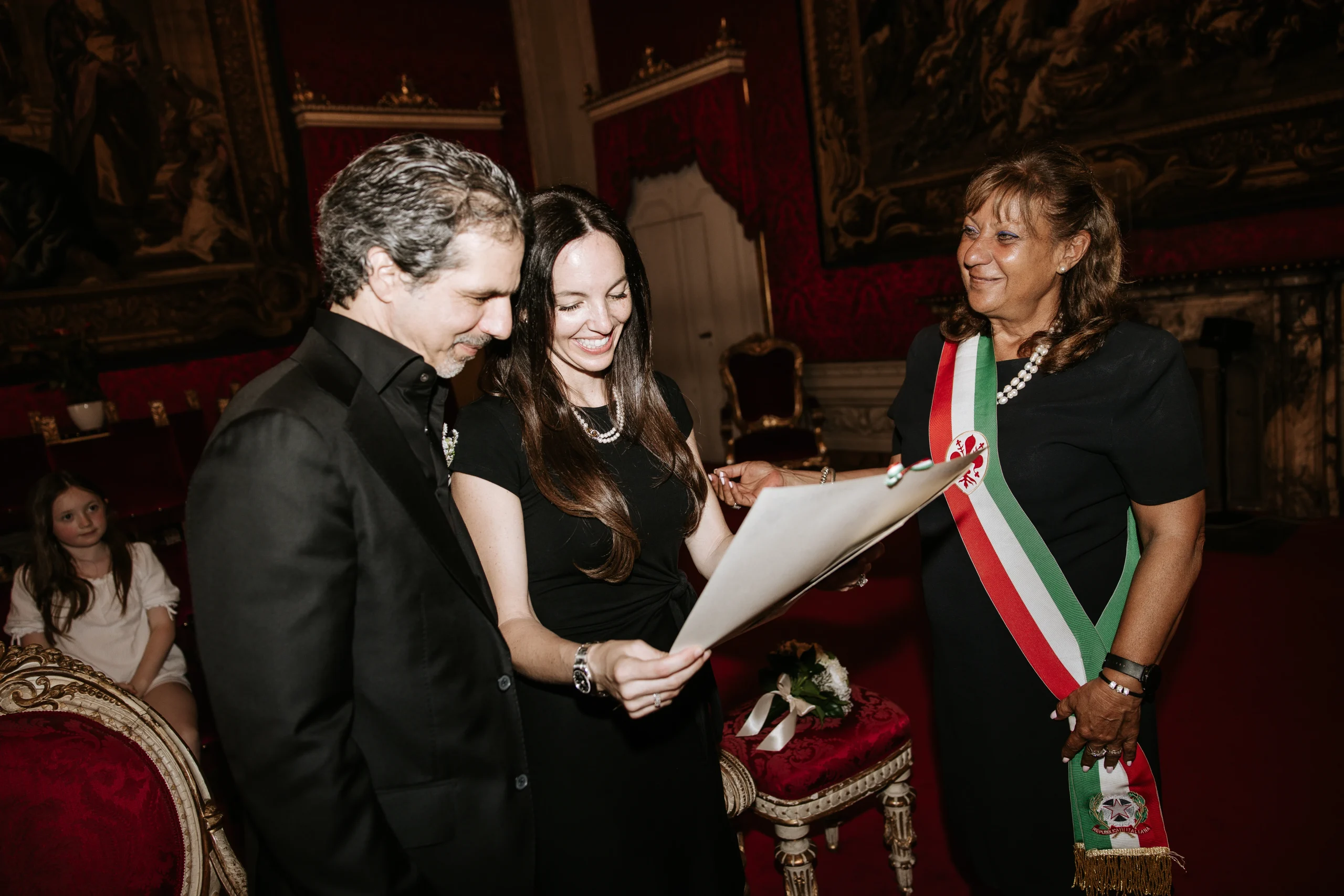
If you are a foreign citizen planning a civil wedding in Italy, and you’re trying to understand how to book the Comune you like in Italy, before looking at the documents you need, you should first understand which procedure applies to you.
There are essentially two different routes.
If neither of you is resident in Italy and neither of you is an Italian citizen residing abroad and registered with AIRE, you will normally not need to complete the Italian marriage banns (pubblicazioni di matrimonio).
The procedure is therefore generally quicker.
Before the wedding, you will normally be required to appear before the Civil Status Officer and make the declarations required by the Comune concerning the absence of legal impediments to the marriage. If you do not speak Italian, an interpreter will also be required.
The appointment usually takes place a few days before the wedding, depending on the Comune.
If, on the other hand, either of you is resident in Italy, regardless of nationality, or one of you is an Italian citizen residing abroad and registered with AIRE, you will normally need to go through the pubblicazioni di matrimonio.
Marriage banns are the formal procedure required by Italian law to make the couple’s intention to marry public before the marriage can take place.
Once you know which of these two routes applies to you, you can understand how to deal with the Comune, when the wedding can be booked and which documents you will need to provide.
Which office of the Comune should you contact?
For a civil marriage, the competent office is the Ufficio di Stato Civile, or Civil Status Office.
Depending on the Comune, however, you may find it under different names on the municipal website, such as:
Ufficio Matrimoni, Stato Civile, Anagrafe e Stato Civile or Servizi Demografici.
This sometimes creates confusion because the Anagrafe and the Stato Civile perform different functions, even though many municipalities organize them within the same department.
When contacting the Comune, make sure that your request reaches the officer responsible for marriages and civil status, rather than simply a general municipal information office.
What should you ask the Comune before booking?
The first contact with the Comune should establish whether your civil wedding is actually possible on the date and at the location you have chosen.
You should ask whether the date is available, which civil wedding venues can be booked, what municipal fees apply, when the documents must be submitted and when the spouses will need to appear personally before the Civil Status Officer.
You do not need to ask the Comune to provide an interpreter or witnesses. The interpreter must be identified and hired by you, and you must also arrange your own witnesses as the Comune cannot provide for interpreter and witnesses.
What you need to do is provide the Comune with the required documents for the interpreter and witnesses, arrange the interpreter’s oath where required, and make sure they are present at the relevant appointments and at the civil wedding ceremony.
What if the Comune does not reply?
Communication with Italian municipalities is not always immediate, depending on the personnel available in the office “Stato Civile”.
Start by using the specific email address of the Civil Status (Stato Civile) or Marriage Office (Ufficio Matrimonio) rather than a generic municipal address.
If you do not receive a response, you can send the request through P.E.C., Posta Elettronica Certificata, to the official PEC address of the Comune or of the Civil Status Office.
A message sent from one P.E.C. address to another produces certified evidence of sending and delivery and has the same legal value as a registered letter with acknowledgment of receipt.
Keep both the receipt of acceptance (accettazione)and the receipt (consegna) of delivery.
P.E.C. can therefore be particularly useful where you need to establish that a formal request was actually delivered to the Comune.
The document required under Article 116 of the Italian Civil Code
If one or both spouses are foreign citizens, the Comune will also need to verify their legal capacity to marry.
Article 116 of the Italian Civil Code requires a foreign citizen wishing to marry in Italy to present a declaration from the competent authority of their country showing that, according to the law applicable to that person, there is no impediment to the marriage.
The document is not always called Nulla Osta.
Depending on nationality and the applicable international rules, it may instead be a:
- Nulla Osta issued at the foreign Consulate in Italy;
- Nulla Osta issued in the home country (e.g. Norway, Sweden).
- Certificate of Legal Capacity to Marry (Countries who are part of the Munich Convention);
- Certificate of No Impediment (United Kingdom);
- sworn declaration/dichiarazione giurata combined with an Atto Notorio (US Citizens);
- or another document issued in the spouse’s home country in accordance with the requirements established by the Italian Government under a bilateral agreement with the country of which the spouse is a national, (e.g. Mexico, Poland, Finland, Lithuania).
The procedure and competent authority vary significantly according to nationality.
For this reason, the Article 116 documentation should be considered separately from the actual booking of the Comune.
If neither of you is resident in Italy
Where both spouses are foreign citizens and neither is resident or domiciled in Italy, Italian marriage banns are generally not required.
However, this does not mean that you simply arrive at the Comune on the wedding day.
Before the ceremony, the spouses are normally required to appear before the Civil Status Officer and sign a formal record declaring that there are no impediments between them that would prevent the marriage under Italian law.
The declaration concerns, among other matters, impediments arising from kinship, affinity, adoption or affiliation, together with the other impediments provided for by the Italian Civil Code.
In particular, Article 116 expressly refers foreign citizens to the Italian impediments contained in Articles 85, 86, 87, 88 and 89 of the Civil Code, within the limits specified by Article 116 itself.
This preliminary declaration is often scheduled a few days before the wedding (in our experience most of the time two days before the wedding day).
However, the exact timing is determined by the individual Comune.
You should therefore never book your flights assuming that arriving in Italy the evening before the wedding will be sufficient.
The interpreter
If either spouse does not understand Italian sufficiently to understand the legal declarations being made, the Comune will require an interpreter.
The interpreter may be required both:
during the preliminary declaration before the Civil Status Officer; and during the civil wedding ceremony itself.
The Comune normally does not provide the interpreter, so this should be organized in advance.
It is also advisable to check whether the Comune where you intend to marry requires an interpreter if one of the wedding witnesses does not understand Italian.
Wedding witnesses
The Comune will ask for the personal details and identity documents of the wedding witnesses before the ceremony.
These are the witnesses to the marriage ceremony itself.
They should not be confused with witnesses who may be required for a completely different legal formality, such as an Atto Notorio.
The Comune should therefore be asked in advance when copies of the witnesses’ passports or identity cards must be provided.
Choosing the matrimonial property regime
Another issue that should be considered before the wedding is the matrimonial property regime.
For international couples, this question can be more complex than simply choosing between the Italian concepts of comunione dei beni and separazione dei beni.
Where Regulation (EU) 2016/1103 applies, Article 22 allows spouses or future spouses to choose the law applicable to their matrimonial property regime.
The chosen law may be:
the law of the State in which either spouse is habitually resident when the agreement is concluded; or
the law of a State of which either spouse is a national at that time.
If no valid choice is made, Article 26 of the Regulation contains rules determining the applicable law.
For an international couple, it is therefore worth considering this question before the wedding rather than treating the matrimonial property regime as a simple administrative question asked by the Comune.
Can you legally marry outside the Town Hall?
Sometimes, yes.
A civil marriage does not necessarily have to take place inside the physical Town Hall.
Italian municipalities may establish separate Civil Status Offices and authorize other locations for civil ceremonies. This can include historic buildings, villas, gardens and other spaces.
However, a beautiful venue is not automatically a legally authorized civil wedding venue.
The Ministry of the Interior has clarified that an external location must have been formally connected to the municipal civil-status function and be legally available to the Comune with sufficient continuity. It cannot simply be transformed into a civil wedding venue for one individual wedding.
For this reason, some municipalities have several authorized external venues, while others celebrate legal civil marriages only in specific municipal rooms.
You should always ask the Comune whether the exact venue or outdoor area you are considering is authorized for the legal civil ceremony.
Municipal fees
Civil wedding fees are established by each Comune and can vary considerably.
The cost may depend on whether either spouse is resident in the municipality, whether the ceremony takes place in a historic municipal venue or at an authorized external venue, as well as on the day of the week and the time of the ceremony.
An authorized historic villa or external location may therefore have a substantially higher municipal fee than a ceremony celebrated in the standard municipal wedding room.
Always ask for the current official tariff when requesting availability.
What happens after the wedding?
After the ceremony, the Civil Status Officer registers the marriage and the marriage act becomes part of the Italian civil-status records.
At that point, different documents can be requested from the Comune.
It is important to understand the difference because they do not all contain the same information and they are not interchangeable for every purpose.
Marriage Certificate
The certificato di matrimonio is the simplest certification of the marriage.
It confirms the essential information relating to the marriage, such as the identity of the spouses and the place and date of the marriage.
It can be sufficient where an authority simply requires evidence that the marriage exists.
It does not provide the same level of information as an extract from the marriage act.
Estratto per riassunto dell’atto di matrimonio
The estratto per riassunto dell’atto di matrimonio contains more information than the ordinary marriage certificate.
In addition to the essential details of the marriage, it may contain the annotations recorded on the marriage act, including information concerning the matrimonial property regime and subsequent events affecting the marriage.
For this reason, it is often the more useful document when the marriage must subsequently be presented to another authority.
In our work, we normally request the estratto per riassunto dell’atto di matrimonio a few days after the wedding, once the marriage act has been registered by the Comune. This is particularly useful because the extract can also show the choice made by the couple regarding their matrimonial property regime.
The next step is to make the document usable in the country where the couple intends to present it.
Before requesting any Apostille, legalization or translation, we first need to check which international convention, if any, applies between Italy and the destination country, and what that country requires for the recognition of the Italian marriage document.
If the destination country is a party to the Hague Apostille Convention of 5 October 1961, and no other convention removes the need for an Apostille, we normally request the competent Italian authority to place an Apostille on the marriage extract.
Where a translation is also required, we can appoint a translator in Italy. After translating the document, the translator can swear the accuracy and fidelity of the translation before the competent judicial office through the procedure known as asseverazione.
The sworn translation is itself an Italian public document. Where required for use in the destination country, the competent Procura della Repubblica can then place an Apostille on the judicial certification relating to the sworn translation.
The marriage extract and the sworn translation are therefore separate public documents, and both may need to be properly authenticated in order to be accepted abroad.
If the destination country is not a party to the Hague Apostille Convention, the procedure cannot be determined simply by taking the document to the Prefettura.
In that case, we first need to verify the specific legalization or authentication requirements of the country where the marriage document will be used.
Depending on those requirements, the competent foreign Embassy or Consulate in Italy may have a role in the legalization process.
The translation may likewise be prepared in Italy through an asseverazione before the competent judicial office, or it may be handled through the diplomatic or consular authorities of the destination country, depending on what that country requires.
For this reason, there is no single post-wedding procedure that applies to every international couple. The correct route depends on the country where the marriage document will be used, the authority that will receive it, and the international conventions applicable between that country and Italy.
Multilingual Marriage Extract under the Vienna Convention
Italy is a party to the Vienna Convention of 8 September 1976 on the issue of multilingual extracts from civil-status records.
Where the marriage document is to be used in another State that is also party to the Convention, the Comune can issue the marriage extract on the standardized multilingual form.
The major advantage is that, between States to which the Convention applies, the document is accepted without legalization or translation.
This can make it particularly useful for spouses who need to register or prove their Italian marriage in another Convention country.
It should not, however, automatically be requested for every international couple.
If the destination country is not a party to the Vienna Convention, another form of marriage document may be more appropriate and an Apostille, translation or other formalities may be necessary.
Full Copy of the Marriage Act
The copia integrale dell’atto di matrimonio is the most complete form.
Rather than simply certifying or summarizing the marriage, it reproduces the entire marriage act as recorded by the Civil Status Office.
It may be useful where a foreign authority, court or other institution expressly requires the complete civil-status record.
Like the estratto per riassunto dell’atto di matrimonio, the full copy may also contain information concerning the matrimonial property regime.
The original marriage act itself remains in the Civil Status registers and is not issued to the spouses. For this reason, in most cases the estratto per riassunto dell’atto di matrimonio is the most practical and informative document for proving a marriage celebrated in Italy, as it certifies the marriage and includes the relevant annotations recorded on the act.
For ordinary proof or registration of the marriage abroad, however, the correct document should always be chosen according to the authority and country where it will ultimately be used.
Ask about the post-wedding document before the wedding
For couples who live abroad, it is useful to discuss the post-wedding documentation with the Comune before the ceremony.
Ask how long it normally takes for the marriage or extract can be issued.
Regarding the legalization and Apostille, translation or registration abroad is not a matter for the Comune to determine.
The Comune’s role ends with the registration of the marriage and the issuance of the relevant Italian civil status document. The requirements for using that document abroad depend on the country and authority where it will be presented.
Booking the Comune: keep the two questions separate
When organizing a legal civil wedding in Italy, always separate two questions.
Can this Comune celebrate our wedding on the date and at the venue we want?
and
Can we complete all the legal requirements necessary for the marriage by that date?
These two questions are related, but they are not the same.
The Comune controls the wedding date, the authorized venue, the local administrative procedure and the registration of the Italian marriage act.
Your nationality, residence and personal circumstances determine which legal documents and preliminary procedures must be completed before the marriage can take place.
You therefore need to take into account both the time required to obtain your documents — for example from your Consulate in Italy or from the competent authority in your home country, depending on your nationality — and the time required by the Comune to complete its procedure, celebrate the marriage and subsequently issue the marriage certificate or extract.
Understanding this distinction from the beginning makes the entire process much easier to manage.

About the Author
Alessandro Pirrò is a former legal consultant to the Italian Government in the field of internationalization and an expert in consular affairs, family law and immigration.
He specializes in the legal procedures required for international couples marrying in Italy, including consular requirements, marriage procedures and the recognition of Italian marriages abroad.


