Yes, foreign couples can celebrate a legally valid civil wedding in the Italian Dolomites, including at selected outdoor venues.
The Civil Wedding Venues we propose don’t take place inside a traditional Town Hall.
The ceremony must be conducted by the Mayor, a civil registrar or an authorized delegate.
The marriage itself is valid under Italian law regardless of the spouses’ citizenship and it is legally recognized in the home country according to the International convention or through Consular legalization.
Citizenship, residence and previous marital status determine the documents and procedure that must be completed before the ceremony.
Depending on the case, the couple may need a Nulla Osta, a Certificate of Legal Capacity to Marry, a U.S. consular sworn statement (Dichiarazione Giurata), an Atto Notorio, or marriage banns if either of the couple is Italian national or simply resident in Italy.
Outdoor authorized Venues in the Dolomites
Legal Civil Wedding in Val Gardena
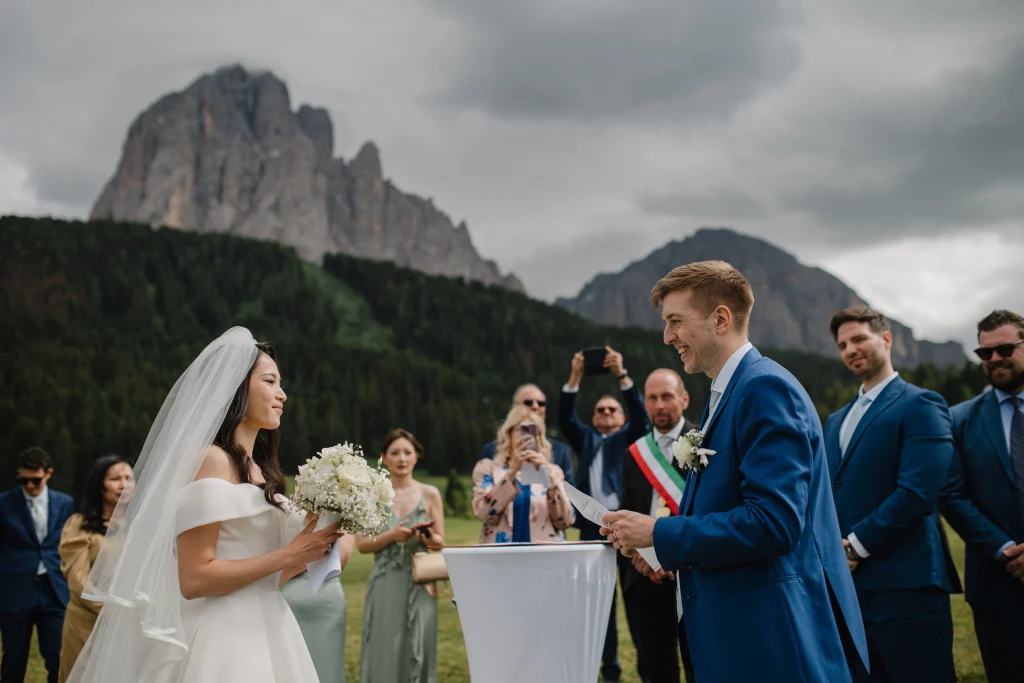
Val Gardena offers the possibility of combining a legally valid civil marriage with an outdoor mountain setting. The ceremony may be conducted by the Mayor or by an authorized delegate at a location approved by the Municipality responsible for that venue.
The photographs from weddings previously coordinated in Val Gardena show that the legal ceremony does not have to resemble a conventional Town Hall wedding.
The civil registrar’s table, the official reading of the applicable provisions of the Italian Civil Code and the signatures of the spouses and witnesses can all form part of an open-air ceremony.
Before confirming a location, it is necessary to identify the competent Municipality and verify whether the site is formally available for a civil wedding on the selected date.
Legal Civil Wedding in Alta Badia
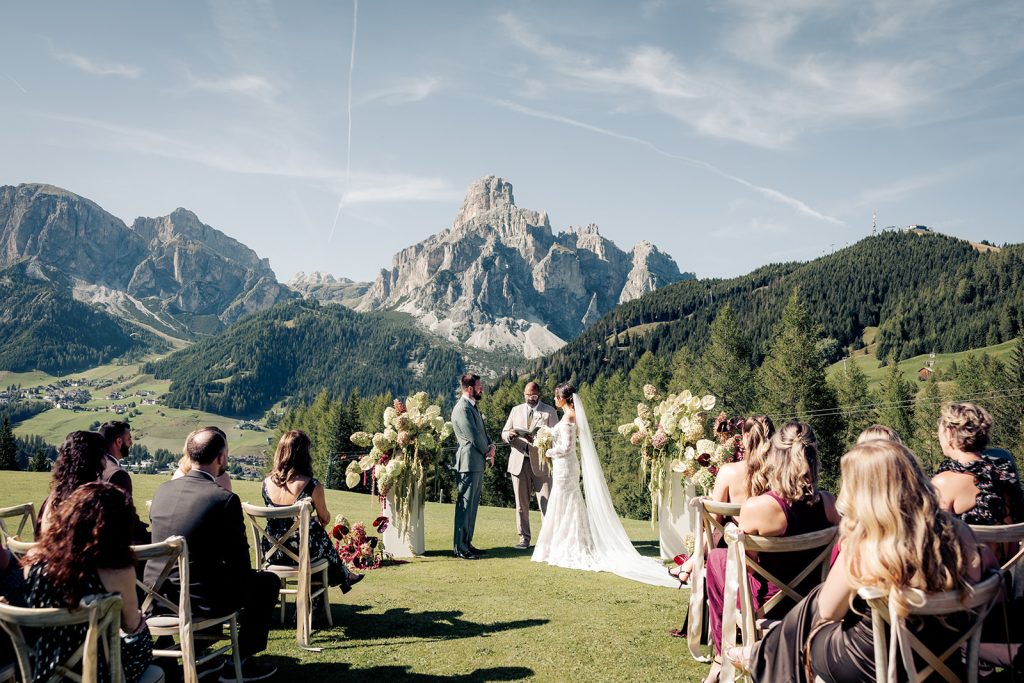
Alta Badia is a geographical area rather than a single Municipality. The competent civil-status office therefore depends on the exact location of the selected venue.
For weddings held within the Municipality of Corvara, Rifugio Edelweiss is currently authorized to host legally valid outdoor civil ceremonies.
The ceremony can take place in the meadow, in the wooded area or on the terrace of the mountain hut. The terrace is covered and therefore also provides an alternative in case of rain. The venue offers views of Sassongher and the Sella Group.
Before the wedding, the couple must also attend a preliminary appointment at Corvara Town Hall.
During this appointment, the civil registrar verifies the original documents and receives the declarations required for the marriage.
The exact timing must be confirmed for each wedding, as it depends on the Municipality’s administrative procedure and availability.
Legal Civil Wedding on Alpe di Siusi
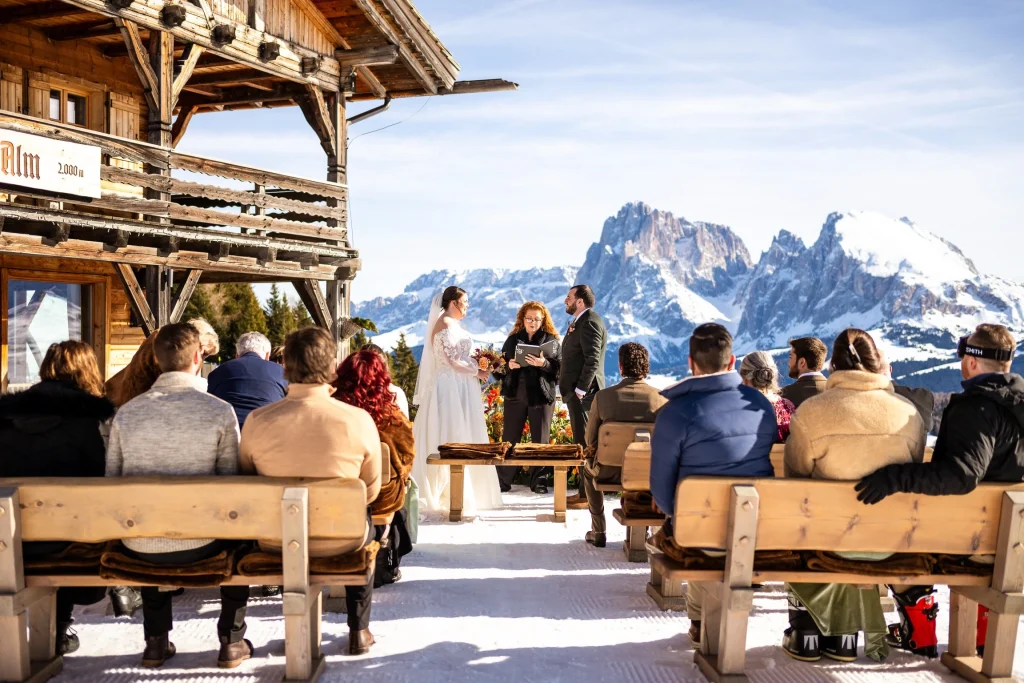
This venue allows the legal civil ceremony to be held either in the lawn of the hotel, the library or on the rooftop with a stunning panoramic view.
The hotel may request the full buyout of the rooms, but this evaluation is related to the season when the civil wedding takes place.
The Municipality, the official ceremony area and any alternative location in case of bad weather must therefore be confirmed before the wedding contract is finalized.
Legal Civil Wedding at 2,000 Meters in a Contemporary Mountain Venue
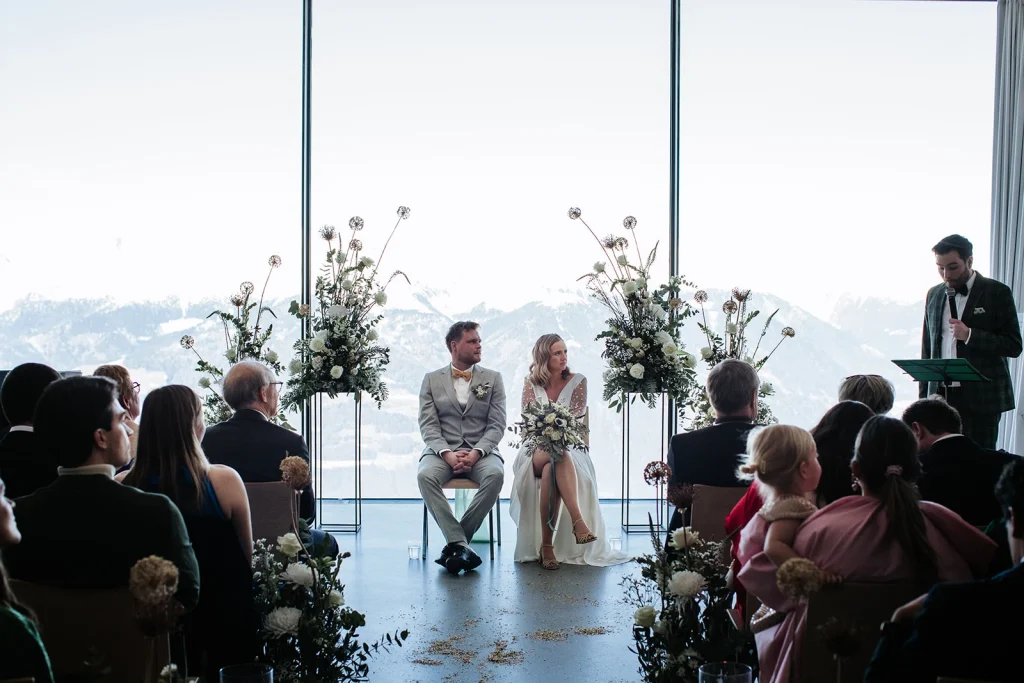
This civil wedding venue is a contemporary structure located on a broad summit plateau in South Tyrol, approximately 2,200–2,300 meters above sea level.
Large glass façades surround the main hall, allowing the ceremony to take place against uninterrupted views of the jagged Dolomites and the surrounding Alpine ranges, whose colors and atmosphere change throughout the day.
The venue sits at the top of a well-known skiing and hiking mountain and is reached by cable car from the valley. The ascent becomes part of the wedding experience, giving guests the feeling of arriving at an exclusive high-altitude retreat.
The legally valid civil ceremony can take place either at this contemporary mountain venue or in a historic castle located in the valley below.
Legal Civil Wedding in a Mountain Hut in Cortina d’Ampezzo
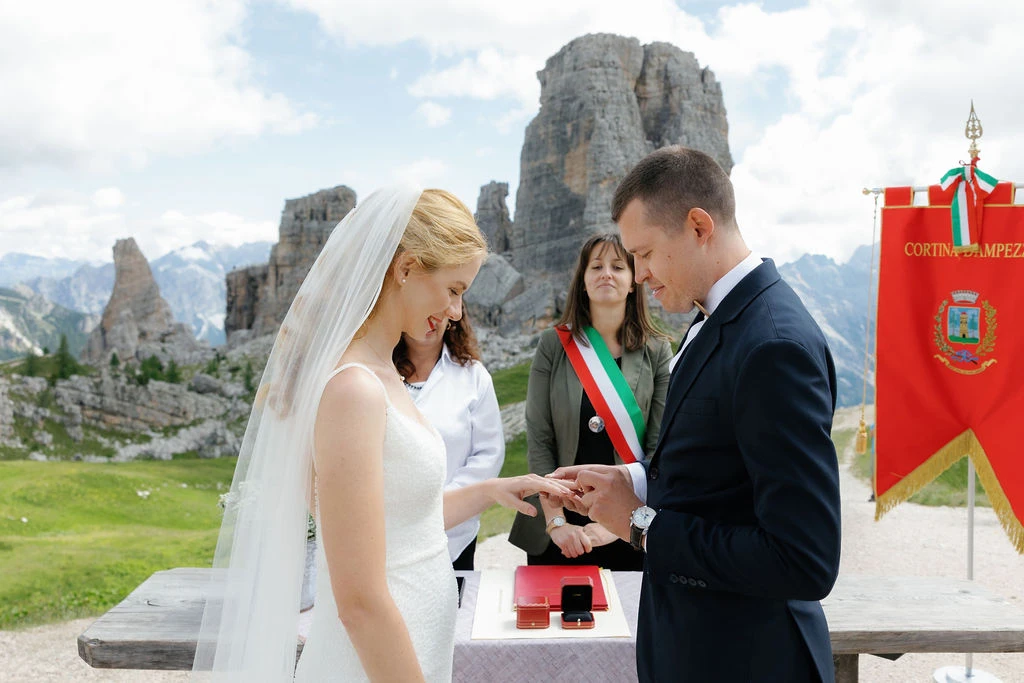
Cortina d’Ampezzo offers outdoor venues where a civil marriage can be celebrated with full legal effect.
The mountain venue for a civil wedding in Cortina is located near one of the most famous sites Cinque Torri in the Dolomites and takes place at a beautiful mountain hut that also hosts a restaurant.
Before the wedding, the couple must complete the preliminary civil-status appointment at the town hall in the town of cortina generally two days before the wedding day.
The date of this appointment must be agreed directly with the municipal office and should be integrated into the couple’s travel plans from the outset, to ensure that all documentation and formalities are in place in time for the ceremony.
On the wedding day, the civil ceremony is held with an incredible view over the Dolomites behind the mayor, who reads out the articles of the Italian Civil Code as is done in every civil rite.
This unique setting allows the couple to experience a legally valid civil marriage immersed in one of the most spectacular mountain landscapes in Italy, combining strict compliance with civil law requirements and the emotional impact of a high-altitude celebration.
Civil Wedding in a Castle in Bolzano

A historic castle settled among the vineyards may also be used for a legally valid civil ceremony in Bolzano since the Municipality has formally designated the property or a specific part of it for civil marriages.
The ceremony can either take place inside an authorized hall of the municipality or in the Castle among the vineyards inside the area of the Municipality of Bolzano.
The legal requirements remain the same: the Municipality of Bolzano must receive and approve the documents generally two days before the civil wedding ceremony and in that occasion the declaration of no impediments of the spouses takes place. The ceremony is generally conducted by a delegated official by the Mayor and two witnesses must be present.
Civil Wedding in Madonna di Campiglio

The local administration offers couples the opportunity to celebrate a legally valid outdoor civil wedding in Madonna di Campiglio, in officially designated natural settings within the Brenta Dolomites.
The available ceremony areas include panoramic high-altitude locations, open Alpine landscapes and a romantic lakeside setting surrounded by forest.
These locations can host both civil marriages and civil unions, allowing couples to combine an official ceremony under Italian law with the scenery of a destination wedding in the Dolomites.
The municipal service includes the formal celebration of the civil ceremony, while any additional arrangements, such as seating, floral decorations, transportation or a weather contingency plan, must be organised separately.
LEGAL REQUIREMENTS FOR A CIVIL WEDDING AT A DOLOMITES VENUE
Choosing the venue is only the first part of the process.
Before confirming that a legal civil wedding can take place there, we need to examine:
- the nationality of each partner and additional nationalities if applicable;
- the country where each partner is formally resident;
- whether either partner is an Italian citizen registered with AIRE;
- whether either partner has been previously married;
- the country or countries where the marriage will later be used or registered;
- the selected venue and Municipality;
- the intended wedding date and travel schedule.
These details determine the correct document, the competent authority, whether marriage banns are required and how much time the couple must spend in Italy before the ceremony.
WHICH DOCUMENTS DO FOREIGN CITIZENS NEED TO MARRY IN ITALY?
There is no single document that applies to every foreign citizen.
Under Article 116 of the Italian Civil Code, a foreign citizen must normally present a declaration from the competent authority of their country confirming that there is no legal impediment to the marriage.
Depending on the applicable national and international rules, this evidence may take the form of:
- a Nulla Osta;
- a Certificate of Legal Capacity to Marry;
- a consular sworn statement (if American);
- a document issued under a bilateral procedure;
- an Atto Notorio in addition to the main consular document (if American or Australian in addition to dichiarazione giurata for Americans and Nulla Osta for Australians).
The appropriate document depends primarily on the spouse’ nationality, residence, previous marriages.
NULLA OSTA
The Nulla Osta is the document contemplated by Article 116 of the Italian Civil Code.
It is the document most commonly required for a foreign citizen to get legally married in Italy. Different procedures apply to citizens of countries that are parties to the Munich Convention and to U.S. and Australian citizens.
The Nulla Osta confirms that, under the law applicable to the foreign citizen, there is no legal impediment to that person marrying the identified partner in Italy.
Depending on the nationality, it may be issued:
- by the foreign Embassy or Consulate in Italy;
- by an authority in the citizen’s country of origin under a specific bilateral procedure agreed with Italy.
A consular Nulla Osta issued in Italy may need to be legalized at the Italian Prefettura where the signature of the issuing consular officer is registered. Exemptions may apply under an international convention or European regulation.
The term Nulla Osta is often used online as a generic label for every marriage-capacity document.
This is inaccurate.
Citizens of Austria, Germany, Greece, Luxembourg, Moldova, the Netherlands, Portugal, Spain, Switzerland and Türkiye may instead use a Certificate of Legal Capacity to Marry issued under the Munich Convention of 5 September 1980.
The sworn statement used by United States citizens follows a different legal framework established by the bilateral agreement between Italy and the United States.
EXCEPTIONS TO THE NULLA OSTA
CERTIFICATE OF LEGAL CAPACITY TO MARRY
Citizens of countries that have ratified the Munich Convention of 5 September 1980 may present a Certificate of Legal Capacity to Marry instead of an ordinary Nulla Osta.
The Convention currently applies to certificates issued for citizens of:
- Austria;
- Germany;
- Greece;
- Luxembourg;
- Moldova;
- the Netherlands;
- Portugal;
- Spain;
- Switzerland;
- Türkiye.
Belgium signed the Convention but has not ratified it and must not currently be treated as a contracting state.
A certificate issued under the Munich Convention is accepted in Italy without legalization or an equivalent formality. The Ministry of Foreign Affairs also states that these certificates are exempt from translation.
The certificate may not contain all the personal information required to prepare the Italian marriage record. The Municipality may therefore also request a birth certificate or another civil-status document, particularly when the parents’ names are not shown.
SWORN STATEMENT (Dichiarazione Giurata) for UNITED STATES CITIZENS
The United States does not issue the declaration normally contemplated by Article 116 of the Italian Civil Code.
United States citizens follow a special procedure based on the exchange of notes between Italy and the United States signed in Rome on 29 July and 18 August 1964 and approved in Italy by Law No. 1195 of 13 October 1965.
The US citizen signs a sworn statement before a United States consular officer in Italy, declaring that there is no legal obstacle to the marriage under the laws applicable to them.
This document is not technically a Nulla Osta. It performs the function assigned to it by the bilateral agreement.
The signature of the US consular officer must normally be legalized by the competent Italian Prefettura before the document can be presented to the Municipality, unless an applicable international convention provides an exemption.
In the procedures we manage for United States citizens, the sworn statement is coordinated with the Atto Notorio and the municipal appointment so that the couple does not have to navigate the Consulate, Prefettura, Court and Town Hall separately.
ATTO NOTORIO FOR UNITED STATES AND AUSTRALIAN CITIZENS
For both United States and Australian citizens, the Atto Notorio is an additional document. It does not replace the U.S. consular sworn statement or the Australian Nulla Osta or Certificate of No Impediment.
The Atto Notorio is a formal declaration made before an Italian Court or another competent Italian authority in the presence of witnesses.
For United States citizens, it forms part of the special procedure used together with the consular sworn statement.
For Australian citizens, it is generally required in addition to the Australian Certificate of No Impediment or other consular marriage-capacity document accepted by the Municipality.
The Atto Notorio may be obtained before an Italian Consulate abroad or directly in Italy.
Obtaining it in Italy is often the more efficient option. Under the Court procedure we coordinate:
- the appointment is arranged in advance;
- the required independent witnesses are provided;
- the couple is assisted during the Court appearance;
- the appointment is coordinated with the consular and municipal stages of the procedure;
- the couple may avoid collecting and translating multiple civil-status records when the competent Court accepts the declaration under its applicable procedure.
The exact requirements must always be assessed before the couple travels. A procedure accepted by one Italian Court should not automatically be assumed to apply before every Court..
WHAT CHANGES IF ONE PARTNER IS RESIDENT IN ITALY?
If one of the partners is formally resident in Italy, the simplified declaration normally used for two non-resident foreign citizens is replaced by the marriage banns procedure.
The banns are initiated before the civil registrar of the Italian Municipality of residence.
The couple must allow time for the statutory publication period and for the subsequent authorization to celebrate the marriage. The wedding may take place in another Italian Municipality once the necessary delegation or authorization has been transmitted.
A short holiday rental or temporary accommodation in Italy does not automatically constitute legal residence. The distinction between residence and temporary stay must be assessed correctly because it changes the competent authority and the procedure.
WHAT CHANGES IF ONE PARTNER RESIDES ABROAD AND IS AN ITALIAN CITIZEN REGISTERED WITH A.I.R.E.?
An Italian citizen who is formally resident abroad and registered with A.I.R.E. must normally request the marriage banns through the Italian Consulate competent for their place of residence.
The foreign partner must still provide the document required for their nationality.
Once the banns have been completed, the Italian Consulate sends the authorization to the Municipality selected for the civil wedding in the Dolomites.
This procedure usually requires more preparation than a marriage between two foreign citizens who are both non-resident in Italy. It should therefore be started well before the wedding date.
STEP-BY-STEP LEGAL PROCESS FOR A CIVIL WEDDING IN THE DOLOMITES
STEP 1: ASSESS CITIZENSHIP, RESIDENCE AND MARITAL STATUS
You must determine which law and procedure apply to each partner.
This includes checking citizenship, formal residence, previous marriages, divorces, widowed status, dual nationality and the countries where the marriage will later be used.
STEP 2: CONFIRM THE VENUE AND COMPETENT MUNICIPALITY
You must verify that the selected venue is authorized for civil marriages and identify the Municipality responsible for the ceremony.
You need to get confirmation of the venue fee, available ceremony areas, indoor alternative and required preliminary appointment.
STEP 3: OBTAIN THE CORRECT MARRIAGE-CAPACITY DOCUMENTS
Each spouse obtains the document required by their citizenship.
This may be a Nulla Osta, Certificate of Legal Capacity to Marry, U.S. sworn statement (Additional atto notorio for Americans and Australians) or another country-specific document. Legalization, apostille and translation are arranged only when required.
STEP 4: COMPLETE THE ATTO NOTORIO WHEN APPLICABLE
United States and Australian citizens in addition to the U.S. sworn statement and the Australian Nulla Osta must obtain the Atto Notorio at any Italian Court.
STEP 5: ATTEND THE MUNICIPAL APPOINTMENT OR COMPLETE THE MARRIAGE BANNS
Two non-resident foreign citizens normally appear before the competent civil registrar to submit the original documents and declare the absence of impediments under Italian law.
If one spouse is resident in Italy or is an Italian citizen registered with AIRE, the marriage banns procedure applies instead.
An interpreter is required if either partner cannot adequately understand Italian. Witnesses are generally not required for the preliminary declaration appointment.
STEP 6: CELEBRATE THE CIVIL WEDDING
The ceremony takes place before the Mayor, civil registrar or authorized delegate.
Two witnesses with valid identification documents must be present. An interpreter must also participate when one or both spouses do not understand Italian.
The official reads the relevant provisions of the Italian Civil Code, receives the spouses’ declarations and signs the marriage record together with the spouses, witnesses and interpreter.
STEP 7: OBTAIN THE MARRIAGE CERTIFICATE FOR USE ABROAD
After the ceremony, the Municipality registers the marriage and issues the appropriate certificate or extract from the marriage record.
The type of certificate, apostille or legalization and translation method must be selected according to the country and authority where the document will be used.
RECOGNITION OF THE ITALIAN MARRIAGE ABROAD
A civil marriage correctly celebrated in Italy is legally valid under Italian law. Its recognition, registration or use as evidence in another country is a separate matter governed by the rules of that country.
When the marriage certificate must be used in a country that is party to the Hague Apostille Convention, the post-wedding procedure may require:
- an Italian marriage certificate or an estratto per riassunto dell’atto di matrimonio;
- an Apostille issued by the competent Italian Prefettura;
- a sworn, certified or professional translation, depending on the requirements of the receiving authority;
- an additional Apostille for the sworn translation when the translation is completed and sworn in Italy and the receiving country requires it;
- registration with a foreign civil-status authority, consulate or other competent institution.
When the country in which the marriage certificate must be used is not party to the Hague Apostille Convention, the document may instead require diplomatic or consular legalization.
The exact procedure depends on the country where the marriage will be registered or used. The requirements should therefore be verified with the competent foreign authority before requesting certificates, translations or legalizations.
FREQUENTLY ASKED QUESTIONS
CAN FOREIGNERS LEGALLY MARRY IN THE DOLOMITES?
Yes. Foreign citizens can celebrate a legally valid civil wedding before an Italian Municipality without becoming residents of Italy. They must present the marriage-capacity documents required for their citizenship and circumstances such as Consular Nulla Osta or Certificate of Legal Capacity to Marry or a sworn statement and an atto notorio if they are american. For Australian it is still required a Nulla Osta but the atto notorio is required as well.
CAN THE LEGAL CEREMONY TAKE PLACE OUTDOORS?
Yes, provided that the outdoor site has been formally authorized by the competent Italian authorities and the ceremony is conducted by the Mayor, civil registrar or an authorized delegate.
IS EVERY DOLOMITES WEDDING VENUE AUTHORIZED FOR CIVIL CEREMONIES?
No. Many hotels, mountain huts and outdoor sites can host symbolic ceremonies but are not authorized for legal civil weddings. The status of the precise venue must be checked with the Municipality.
WHAT IS THE DIFFERENCE BETWEEN A NULLA OSTA AND A CERTIFICATE OF LEGAL CAPACITY TO MARRY?
A Nulla Osta is the declaration normally required under Article 116 of the Italian Civil Code and it issued by the spouse Consulate in italy.
A Certificate of Legal Capacity to Marry is issued under the Munich Convention for citizens of its contracting states and is accepted without legalization or translation.
DO UNITED STATES CITIZENS NEED A NULLA OSTA?
Not in the ordinary sense. United States citizens sign a sworn statement (DICHIARAZIONE GIURATA) before a US consular officer under the special Italy-US procedure approved by Law No. 1195 of 13 October 1965.
In addition to the sworn statement (Dichiarazione giurata) the american citizen must obtain an atto notorio either at the Italian Consulate in the U.S. or before any Italian Court.
WHY DO UNITED STATES AND AUSTRALIAN CITIZENS NEED AN ATTO NOTORIO?
The Atto Notorio supplies formal evidence concerning the person’s freedom and legal capacity to marry as part of the special procedure applicable to those nationalities. It is additional to the principal consular document. It is required by italian bureaucratic praxis according to Law No. 1195 of 13 October 1965.
DO WE NEED TO VISIT THE TOWN HALL BEFORE THE WEDDING?
Usually yes. Two non-resident foreign citizens normally attend a preliminary appointment to submit the original documents and make the required declarations. The timing varies by Municipality. It takes place generally two business days before the civil wedding day.
ARE TWO WITNESSES REQUIRED?
Yes. Two witnesses with valid identification documents must be present only during the civil wedding, not during the declaration of no impediments that takes place before the civil wedding.
IS AN INTERPRETER REQUIRED?
An interpreter is required when one or both spouses do not understand Italian sufficiently to understand the declarations, legal provisions and marriage record.
Please note that many municipalities in the dolomites that celebrates outdoor civil weddings are located in the South Tyrol area, therefore the ceremony can be conducted in German, and the marriage certificate will be both in Italian and German.
HOW LONG DOES THE LEGAL PROCESS TAKE?
It depends on nationality, residence, previous marital status and appointment availability. A procedure completed mainly in Italy may be organized within a relatively short travel period. A case involving marriage banns, consular waiting lists or complex divorce documents may require several months of preparation.
WILL THE MARRIAGE BE RECOGNIZED IN OUR HOME COUNTRY?
The marriage is valid under Italian law once it has been correctly celebrated and registered.
If the Italian marriage certificate is to be used in a country that is party to the 1961 Hague Apostille Convention, it may require an Apostille issued by the competent Italian Prefettura, unless another international agreement provides an exemption. A translation and registration with the competent foreign authority may also be required.
If the certificate is to be used in a country that is not party to the Hague Apostille Convention, the Apostille does not apply. The document may instead require diplomatic or consular legalization, together with any translation and registration required by the country where it will be used.
LEGAL ASSISTANCE FOR YOUR CIVIL WEDDING IN THE DOLOMITES
To receive an initial assessment, send us:
- the nationality of both partners;
- the country where each partner is resident;
- your current marital status and any previous marriages;
- your preferred Dolomites venue or area;
- your proposed wedding date;
- the countries where the marriage must later be recognized or registered.
We will identify the applicable legal procedure, verify the competent Municipality and explain which steps can be completed before your arrival and which appointments must take place in Italy.


