Last update: July, 2026
Best countries to get legally married in Europe and why Italy stands out
When planning to get legally married abroad, many couples wonder: what is the best country in Europe for a civil wedding?
Some destinations are famous for their speed and minimal requirements, while others provide stronger legal guarantees and a once-in-a-lifetime cultural experience.
This guide compares the main European options and explains why Italy is one of the best choices if you want a marriage that is both legally valid worldwide and truly memorable.
| Country | EU status | Documents required (typical) | Timeline | Costs (avg.) | Pros | Cons |
|---|---|---|---|---|---|---|
| Italy | EU | Original birth certificate; Certificate of No Impediment / free status; passport; consular nulla osta as applicable. | 2–3 weeks | €250–€500 (Town Hall fees vary) + translations/legalisations | Strong legal certainty; universal recognition with Apostille; exceptional venues & logistics. | More paperwork; coordination with Consulate required. |
| Denmark | EU | ID; proof of relationship/cohabitation; divorce/death certs if applicable. | ~5–10 days | €295–€400 | Very fast; streamlined process. | Popular slots limited; some home authorities may scrutinise recognition. |
| Gibraltar | non-EU | ID; minimal paperwork; no birth certificate in many cases. | ~7–10 days | €300–€500 | English-speaking; simple rules. | Travel to non-EU territory; recognition can require extra steps. |
| Georgia | non-EU | Passport (often sufficient); local translations issued. | Same day | €100–€200 | Fastest route; minimal requirements. | Outside EU; recognition may require additional legalisation/translation. |
| Malta | EU | Birth certificate; free-status certificate; passports. | ~6 weeks | €150–€300 | EU jurisdiction; English-speaking administration. | Longer lead time than “express” destinations. |
Why Italy requires original documents – and why this is an advantage
Some countries like Denmark or Gibraltar allow marriages without birth or single-status certificates.
While this makes the process fast, it can also create complications when couples return home: certain authorities may question the validity of such marriages.
In Italy, if you rely on your Consulate in Italy, you must provide:
- Your original birth certificate
- Your certificate of free status
These are required for the Consulate to issue the nulla osta, the legal authorization that makes your civil wedding in Italy officially valid.
Far from being “extra bureaucracy,” this guarantees:
- ✅ International validity – Italian certificates legalized with Apostille are accepted by all countries who are parties of the Hague Convention.
- ✅ Legal certainty – full compliance with both Italian and foreign law.
- ✅ Peace of mind – no future problems with recognition in your country of residence.
With professional guidance, gathering these documents is straightforward. Our team assists couples step-by-step, ensuring every certificate is correct and accepted by Italian authorities.
Why Italy is among the best countries to get married in EuropeWhy Getting Married in Italy Is Different
Beyond the legal framework, Italy offers a combination of efficiency, flexibility, and legal protection that very few destinations can match.
Fast and structured legal process
In most cases, the procedure is handled through the relevant foreign consulate in Italy and the local Town Hall. In specific situations, consular involvement is not required at all, such as for countries covered by the Munich Convention of 1980 or other international agreements.
No visa required for the marriage itself
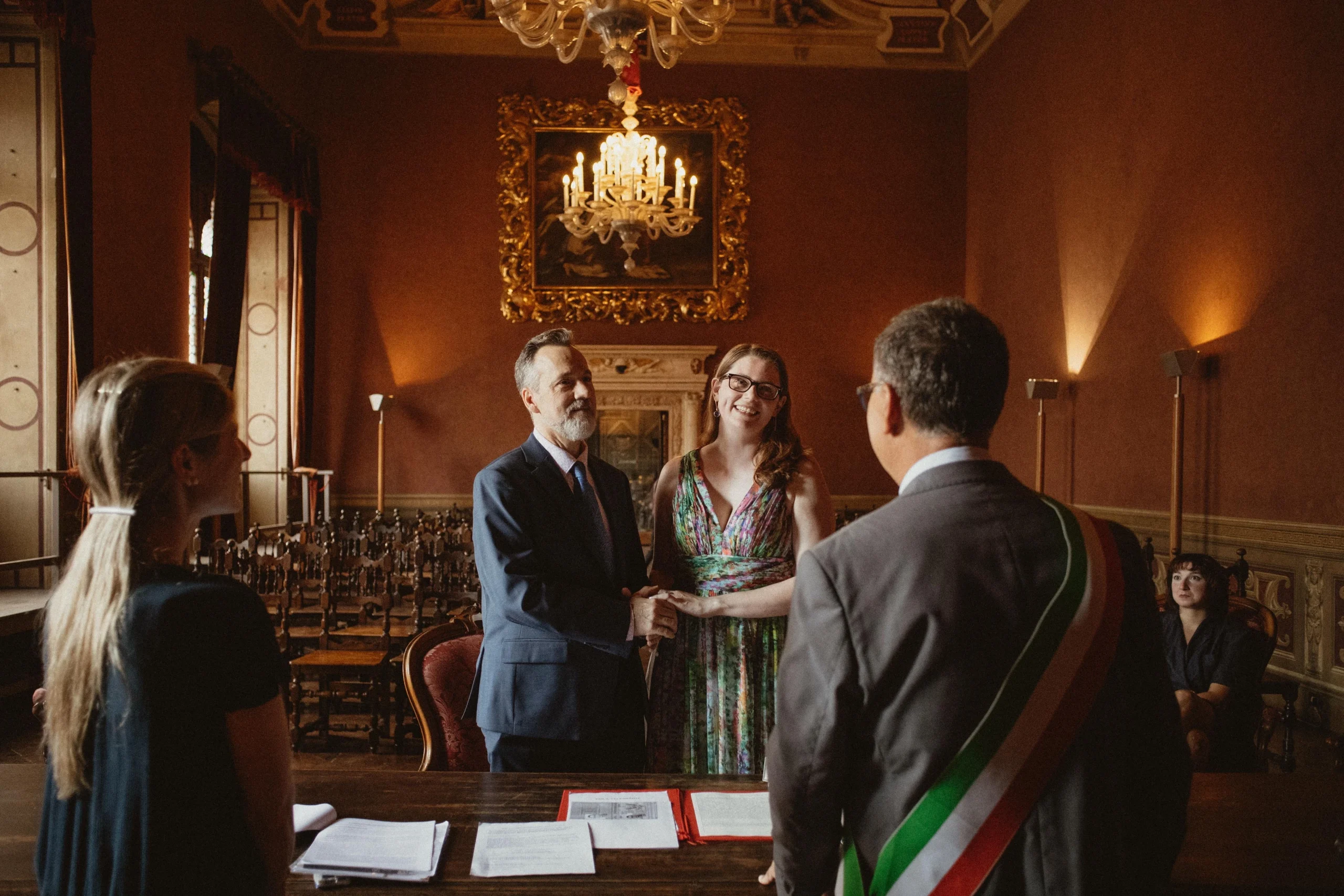
You do not need a specific visa to get married in Italy. This allows couples to combine the legal process with a destination experience, whether in a historic Town Hall, a Renaissance palace, or the Dolomites.
A gateway to family unity in Europe
Marriage in Italy can become a legal basis for family cohesion and future relocation, including pathways connected to family reunification and residence rights within the European framework.
Protection of fundamental rights
Italian authorities apply constitutional and European principles when assessing the validity of a marriage. This means that, even if a foreign legal system restricts or does not recognize a marriage, Italian law will not apply those foreign rules if they conflict with fundamental rights protected in Italy and the EU.
International legal recognition
An Italian marriage certificate, once properly legalized or apostilled and translated in accordance with the applicable international convention (such as the Hague Apostille Convention or the Vienna Convention on Multilingual Extracts of Civil Status Records), is generally recognized across jurisdictions worldwide.
How long does it take to get legally married in Italy?
Once we have provided with your consulate every document they need we can get you married in 10 business days.
‼️Please note that for American and Australian citizens, the process is significantly faster, and the couple can be married within 7 business days.
Thanks to our coordination with Consulates and local Town Halls, we help couples avoid unnecessary delays and make the process smooth.
FAQs about getting legally married in Italy
Is a marriage in Italy valid in the US/UK/Australia?
Yes. With Apostille and legal translation at the Italian Court, Italian marriage certificates are recognized in the US, UK, Australia and in every country that has signed The Hague Convention (apostille).
Do I need to live in Italy to get married there?
No. Foreigners can marry in Italy even without residence, provided they obtain the correct documents.
How much does a civil wedding in Italy cost?
Town Hall fees range from €400 to €1,500, depending on the venue owned by the Town Hall where the civil wedding is to be celebrated. Additional costs may apply for the issuance of the Nulla Osta, court appointments (if required), legal translations, and legalizations.
Do both partners need to be present in Italy before the wedding?
Usually yes, but in certain cases, a marriage in Italy can be completed by only one spouse through a power of attorney.


🇮🇹What if the foreigner spouse is resident in Italy?
If the foreigner is resident or domiciled in Italy, marriage banns (pubblicazioni di matrimonio) are required.
If both parties are foreigners, not resident or domiciled in Italy, instead of requesting marriage publications, they must sign a statement declaring that there are no impediments of kinship, affinity, adoption or affiliation between them, nor any other impediments according to articles 85, 86, 87, and 88 of the Civil Code.
The statement is signed, by appointment with the Civil Status Office, generally one or two days days before the wedding day, presenting the necessary documents (Nulla-Osta for marriage or substitute certification provided by specific agreements/conventions between States).
If the foreign citizen does not have a perfect command of the Italian language, they must be assisted by an interpreter with a legal background, both at the request for publications (or for the statement mentioned above) and during the ceremony, with a suitable identification document.
Written by Alessandro Pirrò
Alessandro is a former legal advisor to the Italian Government and has worked with top law firms in Rome, focusing on international marriage and recognition abroad. He now supports foreign couples getting legally married in Italy, offering expert guidance on paperwork, consular requirements and legal recognition in their home country.
We will be your Legal Counselors for your Civil Wedding in Italy

Due to our experience in law firms and the foreign offices of the Italian public administration, we gained significant expertise in Consular affairs, and we are trained to solve the most complicated procedure such as:
- Marriage Nulla osta process, legalization procedure, Court hearings for the refusal of the town hall when there documents missing , legal translation, apostille procedure, emergency procedure for legalization.
- Immigration law services and consular support for non-EU citizens applying for a Schengen visa.
- Family reunification procedures: Ricongiungimento familare and Coesione Familiare.
- Same-sex couples that want to celebrate a civil union in Italy when in their country the union is forbidden.
- Couples that come from countries where divorce is not allowed;
Italians living abroadregistered at A.I.R.E. that need to recover their document to start the marriage banns in the Italian Consulate. - Assistance with people that come from countries that do not release the nulla osta.
- American and Australian couples who needs assistance with “atto notorio” in an Italian Court or the Italian Consulate in the USA or Australia.
- People with refugee status who have requested asylum in Italy.
For all other matters, please visit our FAQ section.

